


By- Pankaj Belwariar, Director Communications, SRM University -AP
Maslow’s hierarchy of needs offers a powerful lens to understand how humans grow from survival to purpose, and why self-actualization and self-transcendence matter so much in modern life and leadership. For thought leaders, educators, and institutions, this framework is not just theory; it is a roadmap for unlocking human potential at scale.
The evolving hierarchy: six levels
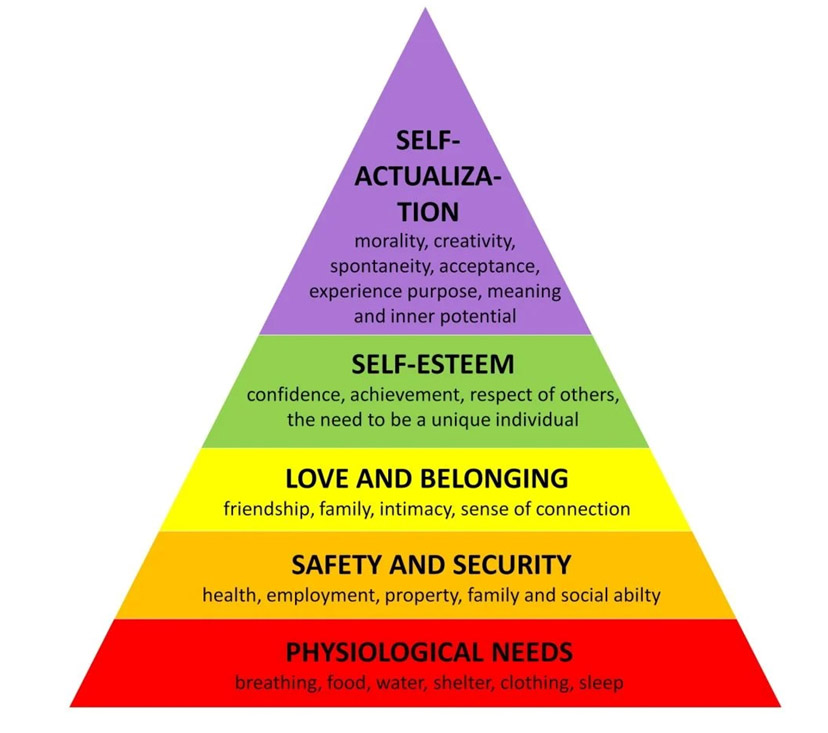
Maslow originally proposed five levels of needs—physiological, safety, love and belonging, esteem, and self-actualization—later extended to a sixth, self-transcendence. The first four are deficit needs: when they are unmet, they dominate attention; when sufficiently fulfilled, they create the psychological space for higher aspirations. Self-actualization and self-transcendence are growth needs, driven by an inner push toward development, meaning, and contribution rather than by lack.
Physiological: dignity in basics
Physiological needs such as food, water, sleep, and shelter form the foundation of human functioning. Any conversation on performance, innovation, or leadership becomes hollow if people are fighting silent battles with fatigue, hunger, or poor health. Thoughtful policy—from canteen quality to hostel design to work-rest balance—is therefore not welfare alone; it is strategic investment in every higher level of the pyramid.
Safety: stability for risk-taking
Safety includes physical security, financial stability, health, and a predictable environment. When people feel unsafe—whether due to job insecurity, harassment, or chronic stress—they instinctively prioritize self-protection over creativity and collaboration. Cultures that embed psychological safety, transparent communication, and fair systems liberate energy that would otherwise be locked in fear, enabling constructive risk-taking and innovation.
Love and belonging: communities that nourish
Humans are wired for connection; belonging to families, peer groups, teams, and communities is a core need, not a luxury. Persistent loneliness or exclusion erodes wellbeing and performance, even when material conditions look “perfect” on paper. Institutions that foster inclusive cultures, peer support, mentoring, and genuine collaboration tap into this level, turning campuses and workplaces into ecosystems of emotional resilience.
Esteem: from validation to inner confidence
Esteem has two facets: the inner sense of competence and self-respect, and the outer experience of recognition, status, and appreciation. Healthy esteem is built when people are trusted with responsibility, given constructive feedback, and recognized for effort and impact, not just outcomes. When this need is nurtured, individuals shift from dependency on external applause to a more stable confidence that fuels long-term achievement and ethical decision-making
Self-actualization: becoming who you can be
Self-actualization refers to realizing one’s full potential and becoming the most authentic version of oneself in work, relationships, and life. It is less about climbing a social ladder and more about aligning one’s talents, values, and actions with a deeply felt inner calling.
Maslow’s research highlighted several recurring characteristics of self-actualizing people. They tend to:
- Perceive reality accurately and honestly, with sensitivity to what is superficial or dishonest.
- Accept themselves and others, including imperfections, with a balance of realism and compassion.
- Be spontaneous and authentic, behaving naturally rather than performing for approval.
- Centre their lives around meaningful tasks or missions that go beyond their ego, often in service of a cause or craft.
- Value autonomy and inner guidance, drawing more on their own judgment than on social pressures.
In this sense, self-actualization is growth-motivated: it is driven by curiosity, creativity, and the desire to express one’s potential, not by fear or deficiency. It is an ongoing process of becoming, not a static state reached once and for all.
When does a person reach self-actualization?
There is no universal checklist or age at which a person “graduates” into self-actualization; it is better understood as a threshold and then a trajectory. Several indicators suggest that a person is operating largely from this level:
- Their primary motivation shifts from “What do I get?” to “What can I create or contribute?” in their chosen field.
- They are less controlled by the need for approval, comparison, or conformity, and more guided by an inner compass of values and purpose.
- They experience “peak experiences” or deep moments of absorption and meaning in their work, art, relationships, or service.
- They handle ambiguity and uncertainty with openness, seeing the unknown as space for learning rather than only as a threat.
Crucially, Maslow himself acknowledged that people may move up and down the hierarchy when life conditions change. A self-actualizing person might temporarily refocus on safety or belonging during crisis, but their overarching orientation toward growth, authenticity, and purpose remains.
Self-transcendence: beyond personal success
In later writings, Maslow proposed a sixth level: self-transcendence, where motivation extends beyond self-fulfilment to intrinsic values such as truth, justice, beauty, and the welfare of others. At this level, individuals are driven by “ego-transcendent” concerns—service, stewardship, and contribution to something larger than themselves, whether a community, a cause, or humanity.
Self-transcendence does not replace self-actualization; it grows out of it. Once a person’s potential is expressed in a healthy way, the natural next question becomes: How can this potential be used for a greater good? Leaders, educators, and professionals who operate from this level become culture-shapers, designing systems where many others can climb the hierarchy in their own unique way.
A thought leadership lens
For institutions, the hierarchy of needs is a strategic framework for human-centred design of policies, pedagogy, and culture—from ensuring physical and psychological safety to designing pathways for esteem, self-actualization, and ultimately self-transcendence. For individuals, especially emerging leaders, it is an invitation to move from ambition to meaning: to build a life where success is measured not only by what is achieved, but by how fully one becomes—and how deeply one contributes.