
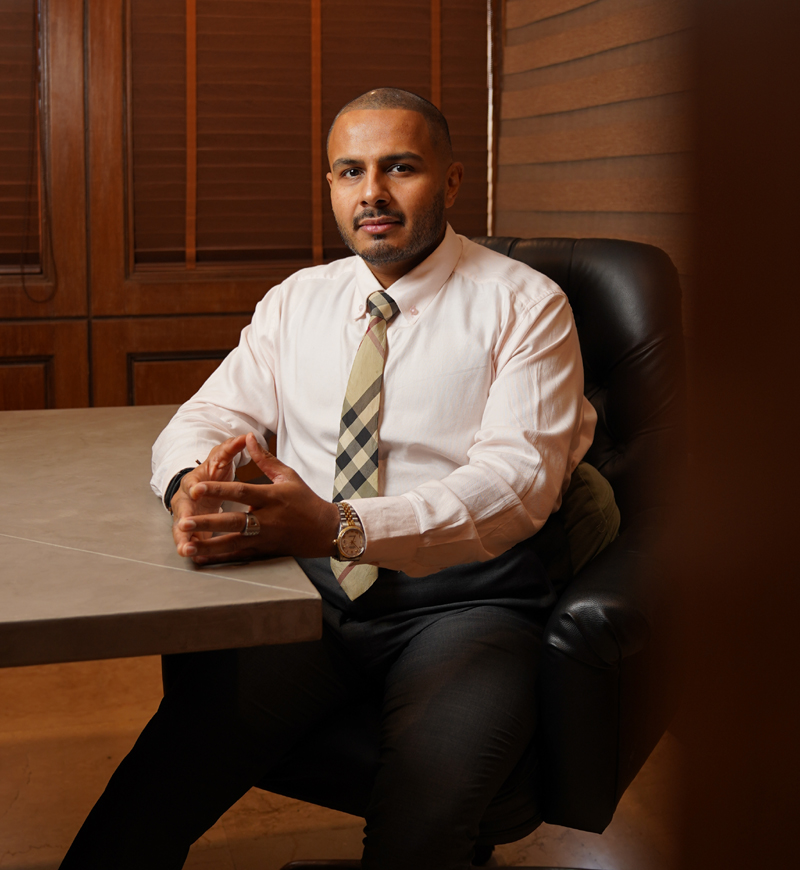
Aditya Earnest John, Founder, How To DXB Real Estat
Whenever there is global uncertainty, capital looks for three things: safety, stability, and ease of deployment. Dubai has positioned itself at the intersection of all three, which is why, during periods of geopolitical tension, it consistently emerges as a preferred destination for global wealth. We saw this clearly during the Russia–Ukraine conflict, when a significant amount of capital from affected regions moved into Dubai’s real estate market. The current geopolitical tensions are following a similar pattern not necessarily in the same scale or speed, but in direction.
However, it would be simplistic to attribute this shift purely to conflict. What truly sets Dubai apart is its ability to remove friction from wealth movement and ownership.
In many parts of the world, investors face multiple layers of complexity high taxation, regulatory hurdles, delays in property transactions, and limited transparency. Dubai, on the other hand, has systematically simplified this entire process. Today, an investor can shortlist, evaluate, and even purchase property remotely. There is no tax on wealth, rental income, or capital gains, which significantly enhances net returns. The legal framework is clear, the execution timelines are predictable, and the overall transaction experience is far more efficient compared to most global markets.
Geography also plays a strategic role. Dubai sits within a six-to-eight-hour radius of most major global cities, making it not just an investment destination but also a viable base for global mobility. This becomes particularly relevant for entrepreneurs, family offices, and globally mobile professionals.
What we are witnessing now is not just opportunistic buying driven by fear—it is a structural shift in how global investors think about diversification.
Investors are no longer allocating capital purely based on returns. They are increasingly asking:
- Where is my capital safest?
- Where can I access it easily?
- Where can I build a long-term base for my family and business?
Dubai answers all three.
At the same time, the current environment has created a unique window in the market. While long-term fundamentals remain strong, short-term sentiment has led to selective price adjustments and better entry opportunities, particularly in the secondary market.
This is where experienced capital family offices and ultra-HNIs is becoming active. These investors understand cycles. They are comfortable entering during uncertainty, with a three-to-five-year horizon, to benefit from the eventual recovery.
On the other hand, retail and first-time investors tend to move more cautiously, often waiting for clarity. This divergence is typical in transitional market phases.
Looking ahead, Dubai’s trajectory will depend less on the presence of conflict and more on its continued ability to manage it effectively. The city has, time and again, demonstrated resilience whether during the 2008 financial crisis, the pandemic, or regional tensions.
Each time, it has adapted, recalibrated, and strengthened its position.
In that sense, global conflicts don’t just redirect wealth into Dubai they reinforce why Dubai exists as a global capital hub in the first place.
For investors, the takeaway is clear: this is no longer just a high-yield real estate market. It is a strategic allocation for global wealth preservation and long-term growth.