
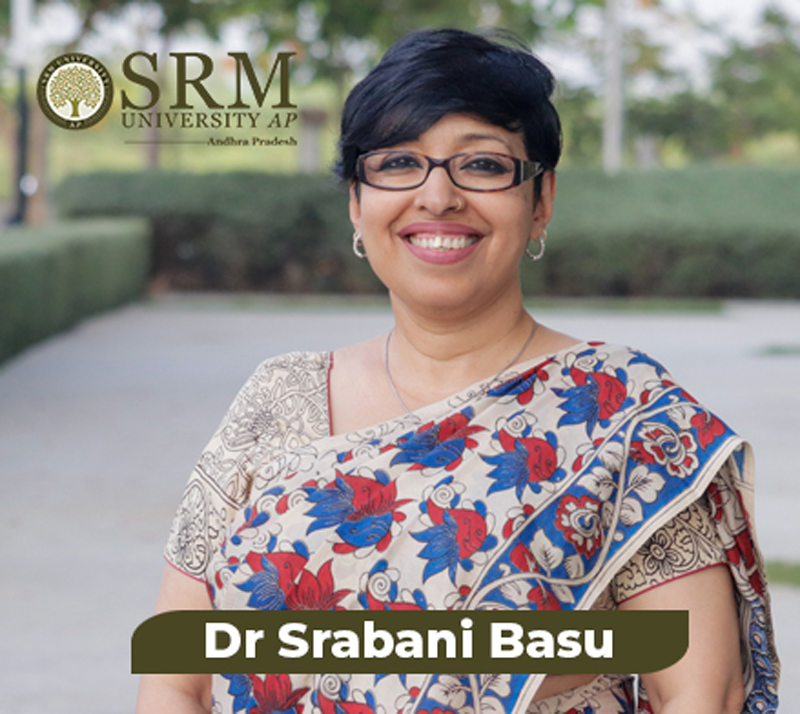
By- Dr Srabani Basu, Associate Professor, Department of Literature and Languages, SRM University AP,
In 2015, the United Nations gave humanity an ambitious blueprint for a better future. The 17 Sustainable Development Goals (SDGs) promised a world free from extreme poverty, hunger and inequality, while striving for quality education, gender equity, climate action and peaceful societies. They told us what the world should become.
A decade later, the uncomfortable question remains: If we know what needs to be done, why are we still struggling to do it?
The problem, perhaps, is not merely technological. Nor is it simply political or economic. It may be profoundly human.
Over the past several decades, humanity has produced extraordinary scientific knowledge. We understand climate change better than ever before. We know how education transforms societies. We possess enough agricultural knowledge to feed the world. We have sophisticated models for inclusive governance, organisational leadership and sustainable business.
Yet knowledge alone has not translated into collective action.
The paradox is striking. We have become increasingly intelligent as a civilisation, but not necessarily wiser.
This is precisely where the Inner Development Goals (IDGs) enter the conversation.
The IDGs were created as a complementary framework to the SDGs, based on a simple but transformative proposition: outer change requires inner development. If the SDGs define the destination, the IDGs explore the human capacities required to reach it. Rather than focusing on infrastructure, policies or economic indicators, they ask an unusual question: What qualities must individuals, leaders and institutions cultivate if meaningful global transformation is to occur?
The framework identifies five interconnected dimensions of human development: Being, Thinking, Relating, Collaborating and Acting. These dimensions encompass capacities such as self-awareness, critical thinking, empathy, perspective-taking, courage, trust, creativity and long-term orientation. These are not presented as personality traits reserved for a gifted few, but as developmental capacities that can be intentionally nurtured across individuals, organisations and communities.
This shift is more significant than it first appears.
Consider climate change. Scientific evidence has accumulated for decades. Yet action often stalls because of denial, short-term thinking, ideological polarisation or the inability to cooperate across competing interests. Similarly, organisational transformation rarely fails because leaders lack strategic plans. It falters because people struggle with uncertainty, fear, ego, resistance to change or an inability to build trust.
In other words, many of our global challenges are not problems of information alone; they are challenges of human consciousness and collective behaviour.
For generations, education systems have concentrated on developing cognitive competence. Students learn mathematics, science, economics and literature. Professionals acquire technical expertise. Organisations invest heavily in digital transformation and technological innovation.
Far less attention has been given to cultivating reflective awareness, emotional regulation, ethical judgement, systems thinking or the capacity to engage constructively with diverse perspectives. Yet these capacities increasingly determine whether technical knowledge can be translated into sustainable action.
The workplace illustrates this vividly.
Artificial intelligence can process unprecedented quantities of information, but it cannot replace moral responsibility. Data analytics can predict market trends, but they cannot generate compassion. Algorithms can optimise decisions, but they cannot determine what is worth optimising in the first place.
As automation increasingly performs routine cognitive tasks, distinctly human capabilities become more valuable rather than less. Curiosity, empathy, creativity, ethical reasoning and collaborative intelligence are no longer “soft skills.” They are becoming strategic capabilities for navigating complexity.
This has profound implications for leadership.
The traditional image of leadership often celebrated certainty, authority and individual brilliance. Today’s interconnected world demands something different: leaders who can hold ambiguity without paralysis, listen before reacting, integrate competing viewpoints, admit uncertainty and inspire collective action.
These are precisely the capacities that the Inner Development Goals seek to cultivate.
Perhaps the greatest contribution of the IDGs lies in reframing sustainability itself. Sustainability is often discussed in terms of carbon emissions, biodiversity, renewable energy or responsible consumption. These remain essential. But sustainability is also about sustaining healthier ways of thinking, relating and acting.
After all, environmental degradation begins long before forests are cut down. It begins in mindsets that separate humans from nature.
Social inequality begins long before statistics reveal widening income gaps. It begins wherever empathy gives way to indifference.
Conflict rarely starts with weapons. It begins with rigid identities, fear and the inability to see another person’s perspective.
The external world often reflects the architecture of the internal world.
This perspective resonates with insights from psychology, neuroscience and leadership research. Human behaviour is shaped not merely by rational calculation but by emotions, beliefs, identity, unconscious biases and social relationships. Sustainable development therefore cannot rely solely on changing systems; it must also engage with the people who create, operate and transform those systems.
Educational institutions may have a particularly important role to play.
Imagine schools where curiosity is cultivated alongside content knowledge. Universities where critical thinking includes intellectual humility. Business schools where strategy is taught together with ethical courage. Professional development programmes that value self-awareness as much as technical expertise.
Such institutions would not merely prepare students for employment; they would prepare citizens capable of navigating an increasingly complex world.
The same principle extends to organisations. Companies pursuing Environmental, Social and Governance (ESG) goals often invest in sustainability reporting, governance frameworks and operational improvements. These are necessary. Yet without leaders capable of long-term thinking, collaboration and trust-building, many sustainability initiatives remain performative rather than transformative. Increasingly, organisations are exploring the IDG framework as a way of developing the human capabilities needed to support lasting change.
As 2030 approaches, the world faces an uncomfortable reality. Achieving the SDGs will require more than better policies, more sophisticated technologies or larger investments. These remain indispensable, but they are insufficient in isolation.
The future may depend equally on our capacity to become more reflective without becoming passive, more compassionate without sacrificing courage, more collaborative without abandoning critical thinking, and more innovative without losing our ethical compass.
Perhaps sustainable development has always been an inside-out process.
The SDGs remind us what humanity hopes to achieve.
The Inner Development Goals remind us who humanity may need to become in order to achieve it.
In the end, the most important sustainable resource may not be found beneath the earth, within our economies or inside our technologies.
It may reside quietly within ourselves.


