

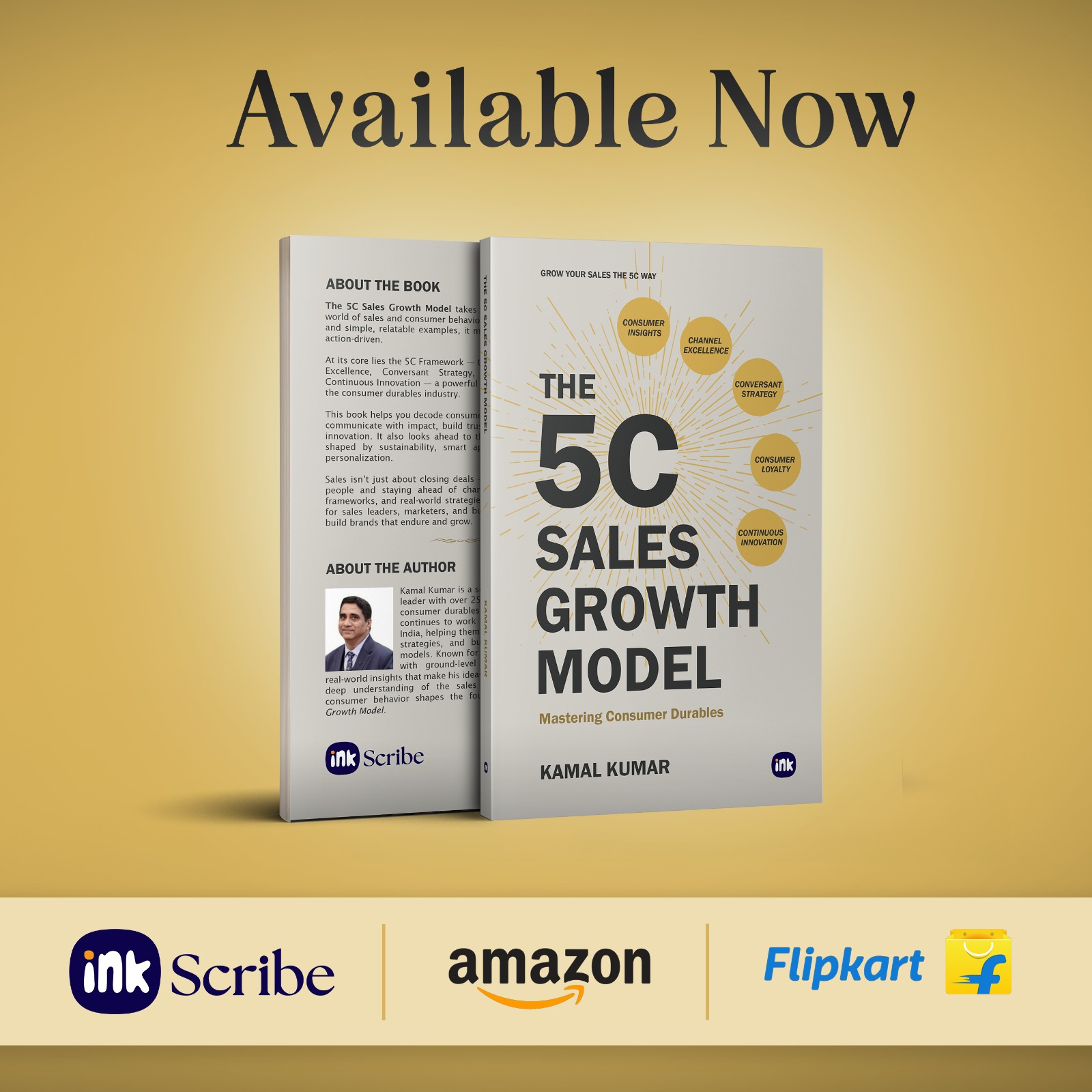
In an exclusive interview with Kamal Kumar—Author of The 5C Sales Growth Model and a seasoned Business Transformation Expert—we explore the journey of a leader who has remained relevant across decades in the consumer durables sector. With over 25 years of deep, on-ground experience spanning fans, small appliances, and air-conditioners across both Indian and multinational organisations, Kamal has built, led, and transformed sales ecosystems through every major shift the industry has witnessed.

Known for his rare ability to merge ground realities with strategic clarity, he has shaped distribution networks, strengthened retail channels, influenced brand thinking, and mentored teams toward sustainable growth. His newly released book distills decades of wins, failures, insights, and market shifts into one practical, actionable framework—The 5C Sales Growth Model.
In this conversation, Kamal reflects on the inspiration behind the model, pivotal moments from his career, and the one “C” he believes every aspiring sales leader must master to thrive in today’s consumer-driven landscape.
1. What inspired you to turn 25+ years of consumer durables experience into the “5C Sales Growth Model”?
Over the years, I noticed something interesting. Companies change, categories change, even teams change, but the core challenges in sales stay the same.
I kept seeing the same patterns repeat weak insights…. broken channels, unclear communication, loyalty not being built the right way, and innovation coming in only when things went wrong.
At some point, I felt the need to put all my learnings into one simple structure that anyone in sales could use.
The 5C Model is really the heart of my journey… the wins, the mistakes, and the lessons, all organised in a way people can apply from day one.
2. Was there a defining moment in your career when applying one of the Cs changed the course of a market or business you handled?
There was a moment that stays with me even today.
A brand I was handling suddenly saw a sharp drop in repeat purchases. Everyone believed the problem was pricing, but something felt off.
When we started speaking to retailers and consumers, we discovered the real issue. Customers were not receiving timely after-sales support. It had nothing to do with price. It was a trust problem.
We focused on rebuilding Consumer Loyalty by improving service response and restoring faith among retailers.
In three months, repeat sales recovered and the brand regained its position.
That was when I realised how powerful loyalty really is. It does not make noise, but it silently decides the fate of a brand.
3. What was the toughest part of converting real field realities into a structured framework that leaders across industries can use?
The toughest part was removing the noise.
Sales on the ground is full of unpredictable elements. Distributors have their own behaviours, markets change suddenly, competition reacts fast, and internal pressures are always present.
To create the model, I had to focus only on the things that matter everywhere, in every company, in every category.
It meant simplifying without losing the depth.
It also meant creating a structure that a new manager, a mid-level leader, or a business head can all relate to.
That balance was the real challenge.
4. How does your 5C Model help organisations shift from traditional sales habits to today’s consumer-driven and data-influenced market?
The model forces organisations to rethink the basics.
Earlier, sales in India depended heavily on relationships and gut feeling.
Now, consumers are informed, demanding, faster in decision-making, and far more value-conscious.
The 5C Model helps companies move with the new reality.
It guides them to understand consumers better, clean up their channels, communicate with clarity, build genuine trust, and innovate continuously so they stay relevant.
In a way, the model brings discipline to old habits and agility to new expectations
5. For a young sales leader or entrepreneur building from scratch, which one “C” matters the most and why?
For me, it will always be Consumer Insights.
If you get the consumer wrong, everything else becomes guesswork.
But when you understand the consumer well… their habits, pain points, motivations, and expectations… you build your product, your channels, and your strategy on solid ground.
Good insights save money, time and unnecessary effort.
More importantly, they give clarity.
And clarity is the biggest advantage anyone can have when they are starting out.
Amazon: https://tinyurl.com/yn8xuzw4
Flipkart: https://www.flipkart.com/product/p/itme?pid=9781969992117
Inkscribe :https://store.theinkscribe.com/products/the-5c-sales-growth-model