
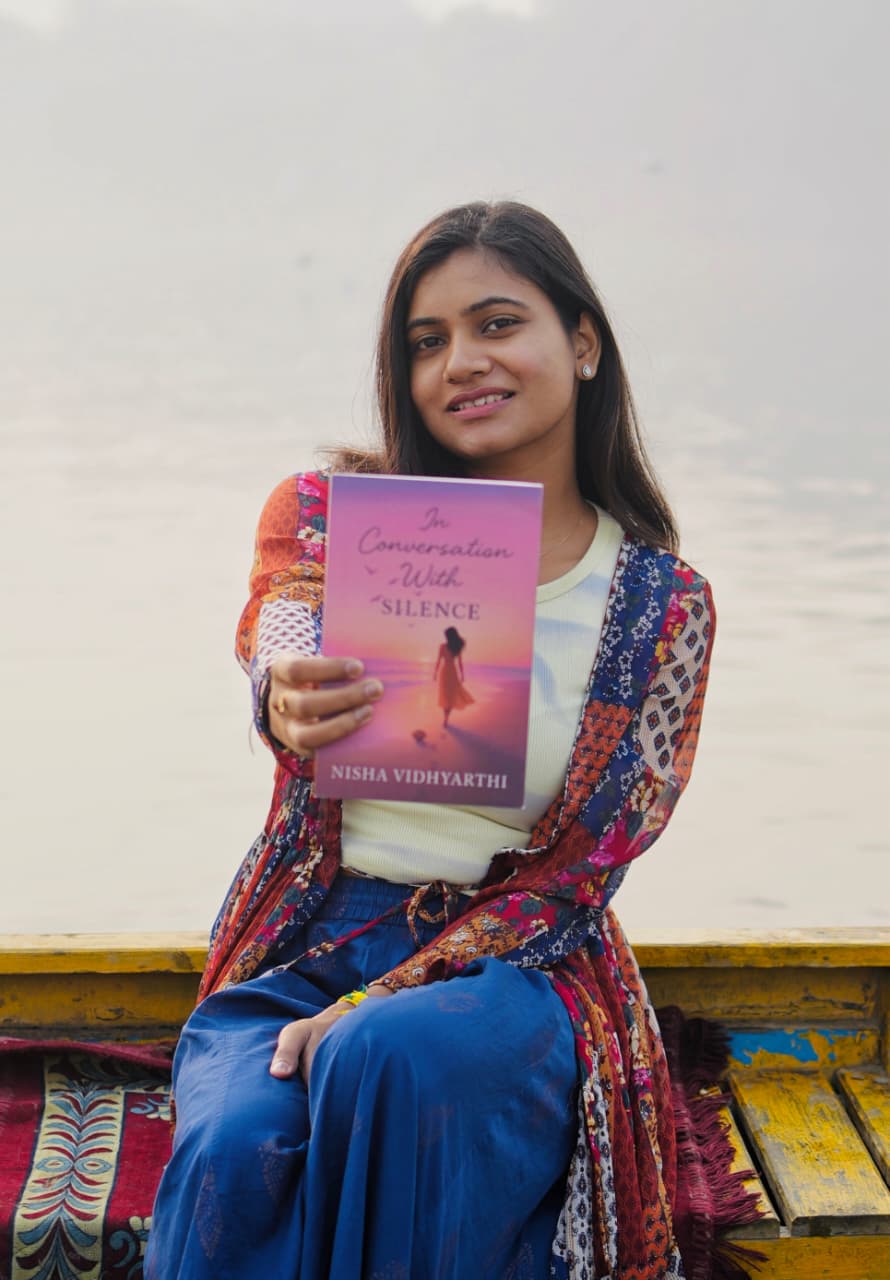
Every once in a while, a collection of poetry emerges that doesn’t just speak—it listens. In Conversation With Silence is one such book. It’s a reflection of life’s delicate balances, its hidden depths, and the quiet revelations that often pass unnoticed. This debut collection invites readers to traverse the emotional landscapes of joy, sorrow, love, and introspection, exploring what lies beneath the surface of everyday existence.
Q1. What draws you to the medium of poetry, and how do you believe it offers a distinctive way to communicate emotions and ideas?
As a child, I often watched my father write poems for me to recite at school events like Hindi Pakhwada. Curiosity led me to write my first poem for Teacher’s Day — more as an experiment than anything else — but the warm reception shifted something within me. Gradually, I found myself writing more.
The rhythm of words, their quiet music, the rawness of thought, and the freedom poetry allows — to explore both emotions and ideas — all drew me in. Poetry became the space where I could question, probe, and give voice to what remains unspoken. In Conversation With Silence is both a reflection and a response to this inner journey.
Q2. Can you share the inspiration behind the themes of your poems, and how it influenced the tone and structure?
Life itself — my own experiences and the emotions I’ve witnessed in others — inspires me. Conversations, moments of solitude, and quiet reflection have allowed me to explore unseen depths within.
My poetry often takes a freestyle tone and structure. It mirrors a mind seeking beyond boundaries: unrestrained, fluid, and honest — just like the emotions it conveys.
Q3. Poetry invites readers to interpret and connect personally. How do you balance conveying your meaning with leaving room for interpretation?
Many times, I’ve rewritten poems because they carried layers of emotion — mine and others’. Reading them at different moments, with shifting perspectives, revealed new meanings each time. That’s how I balance intention with openness, allowing readers to bring their own reflections into the words, which I deeply cherish.
Q4. Can you describe your approach to crafting the musicality of your language?
I’ve explored different poetic instruments and even pursued courses on rhyme and rhythm. Still, the musicality of poetry doesn’t arise from words alone — it flows from meaning. Painting a picture with language creates a quiet melody in the mind. This cadence lets readers connect emotionally, carrying the words beyond the page and into reflection.
Q5. How does your personal journey influence the themes and imagery in your poetry?
My life’s journey and background have shaped both perspective and pen. From humble beginnings to spaces of admiration, every experience, every reading of life, finds reflection in poetry — transforming quietly into words that mirror struggle, stillness, and awakening.
Q6. How do you use poetry as a means of commentary or reflection on the world?
Poetry gives me a space to explore my perceptible limits and lived experiences. It allows me to be both an expert and a novice — someone daring to let words speak yet remaining humble before their meaning. Poetry becomes a mirror to see the world not as it appears, but as it feels: layered, fragile, and infinitely expressive.
Q7. Can you share your writing rituals or practices?
I never had strict rituals. I write whenever the moment calls — in the metro, after a conversation, while traveling, or before bed. Quick notes capture thoughts, reflections, or single lines, later revisited at night — a time I call homecoming. Writing in the moment keeps it honest, simple, and resonant.
Step into the quiet. Hear the words that linger where silence speaks. Grab your copy on Amazon today.