

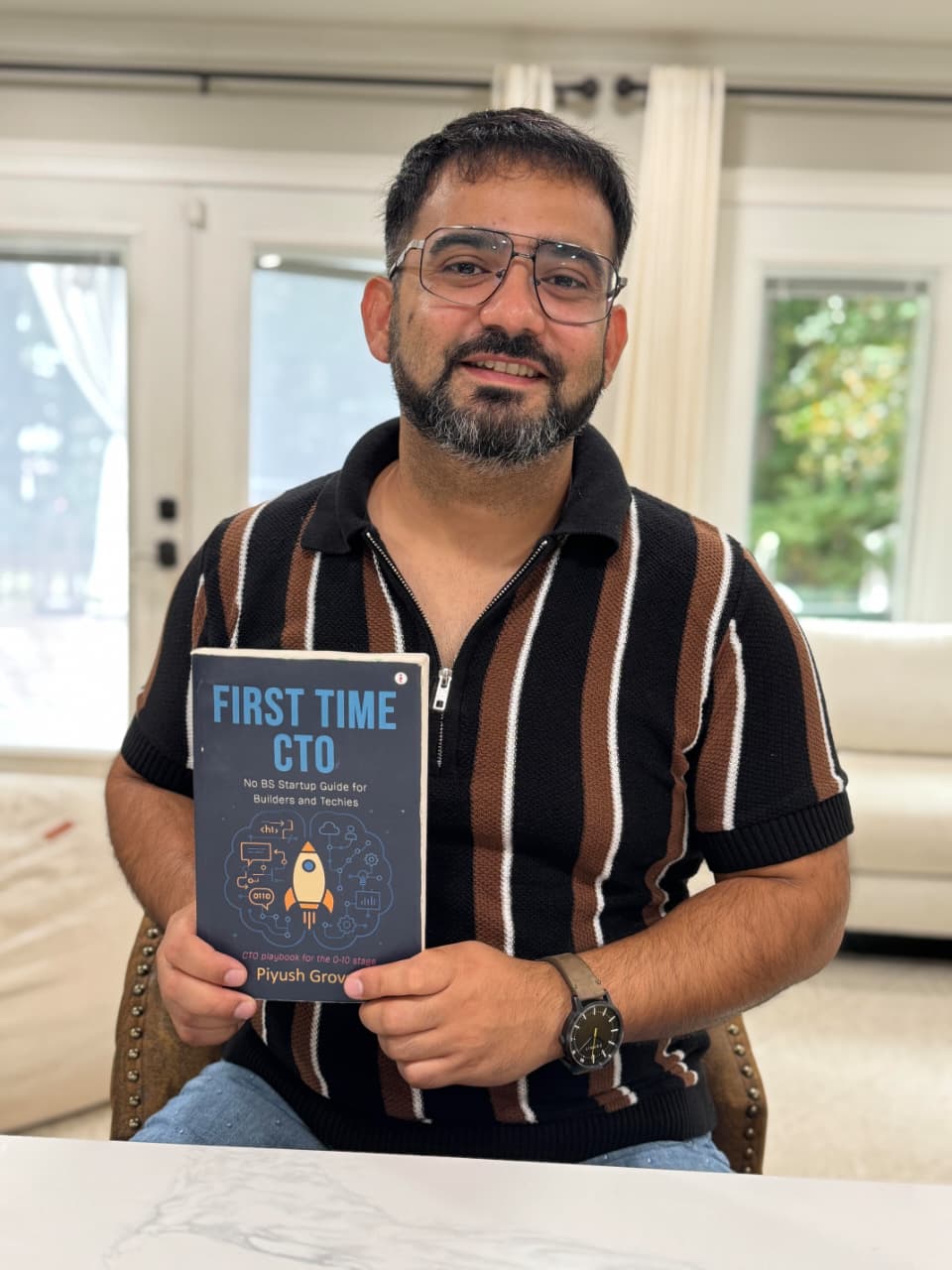
Stepping into the role of a CTO for the first time can feel less like a promotion and more like controlled chaos. In First Time CTO: No BS Startup Guide for Builders and Techies, Author Piyush Grover distills over a decade of hard-earned startup experience into a practical, honest guide for tech leaders navigating uncertainty, limited resources, and high-stakes decisions. Focused on the “why” behind leadership choices rather than rigid playbooks, the book speaks directly to builders, founders, and product leaders shaping startups in a rapidly evolving, AI-driven world.
1. Can you provide an overview of your book and how it addresses key challenges in the world today?
First Time CTO is a no-fluff guide for techies and builders who are stepping into leadership roles in startups or starting up on their own.
It focuses on the “why,” not just the “how.” From building products to building teams on a shoestring budget, navigating the startup journey as a tech or product leader—especially in the age of AI—is not just overwhelming; it’s chaotic.
The book addresses how to navigate both early-stage and growth-stage building, where uncertainty is high and resources are always limited.
2. What inspired you to write this book, and what specific expertise or experiences do you bring to the subject matter?
With over 13 years of experience building tech products from scratch and scaling them in early- and growth-stage startups, I realized there are common patterns in the challenges faced by technology leaders, product managers, and founders who are building technology startups for the first time.
That realization is what inspired me to write this book.
3. Could you share some of the most valuable insights or takeaways that readers can expect from your book?
From building my first startup backed by the Government of India, to leading BlackBuck in its early days (which went IPO in 2024), to helping new-age startups in the AgriTech and fast fashion industries, I realized that creating the right balance between speed and scalability is the top priority for startup CTOs. More often than not, maintaining this balance remains a challenge.
Focused awareness on the “why” behind decisions, combined with an attitude of agility, is what product builders and tech leaders need to pay close attention to.
4. Can you highlight any case studies or real-world examples from your book that illustrate the principles you discuss?
There are numerous case studies and anecdotes in First Time CTO that help readers understand the challenges startups face and how leaders think about overcoming them.
One key principle discussed is decision-making—knowing when to decide on the fly and when to slow down, consult experts, and do deeper analysis.
Think of Amazon in its early days. Choosing a logistics provider was a reversible decision; they could switch if there was misalignment. But starting operations in a new geography? That’s not simple and requires deliberate analysis.
On the surface, distinguishing between these two types of decisions seems easy. But many startups have gone down the drain because of misjudging them.
5. Are there any particular challenges or obstacles you encountered while writing this book, and how did you overcome them?
I had the outline of this book almost ready in my mind by 2021, but I wasn’t fully convinced that these challenges were universal.
However, while taking on fractional CTO roles alongside working on my own startup, I realized that these challenges are common across industries and geographies—and that they can be navigated without feeling overwhelmed or anxious.
6. What do you hope readers will gain from reading your book, and how do you envision it making a positive impact on their lives?
Building a tech startup is fun, but it comes with a lot of uncertainty, especially in the early stages. You never have enough resources, and as a leader, you want to realize your vision by tomorrow while delivering on user demands and managing investor expectations.
Making effective decisions, building what matters, and confidently rejecting what doesn’t is not just necessary—it’s the only way forward.
There are many books on product development, entrepreneurship, and building tech systems, but very few focus on early- and growth-stage tech challenges from a technology leadership perspective.
This book is my honest attempt to capture the messy, funny, and hard-earned lessons of building and leading tech in startups—a no-BS playbook for first-time CTOs, techies, PMs, founders, builders, and anyone who wants to build in the future.
7. In a rapidly changing environment, how does your book stay relevant and adaptable for readers over time?
Time changes. Trends change. Technologies change.
That’s why I intentionally focused more on the “why” and less on the “how” while writing this book. Every startup is unique, with its own journey, challenges, and dynamics.
The emphasis is not to treat my insights as fixed rules, but to help readers cultivate how to think like a CTO and evolve as their startup evolves.
Building a startup doesn’t come with a manual—but this comes close.
No manual. No fluff. Just what works. Buy First Time CTO on Amazon today.