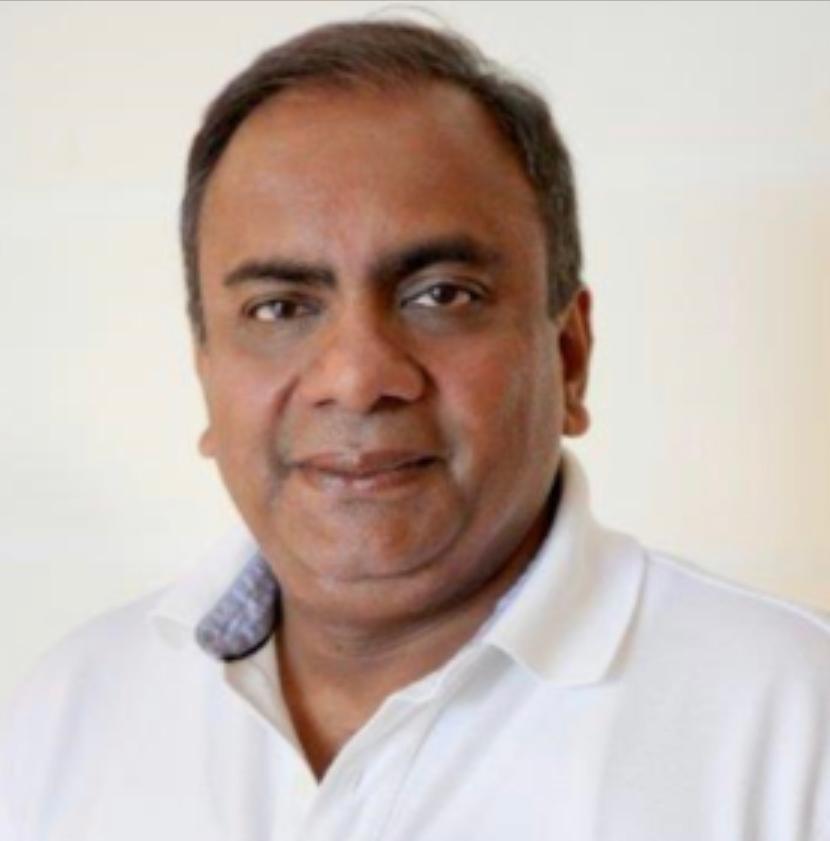

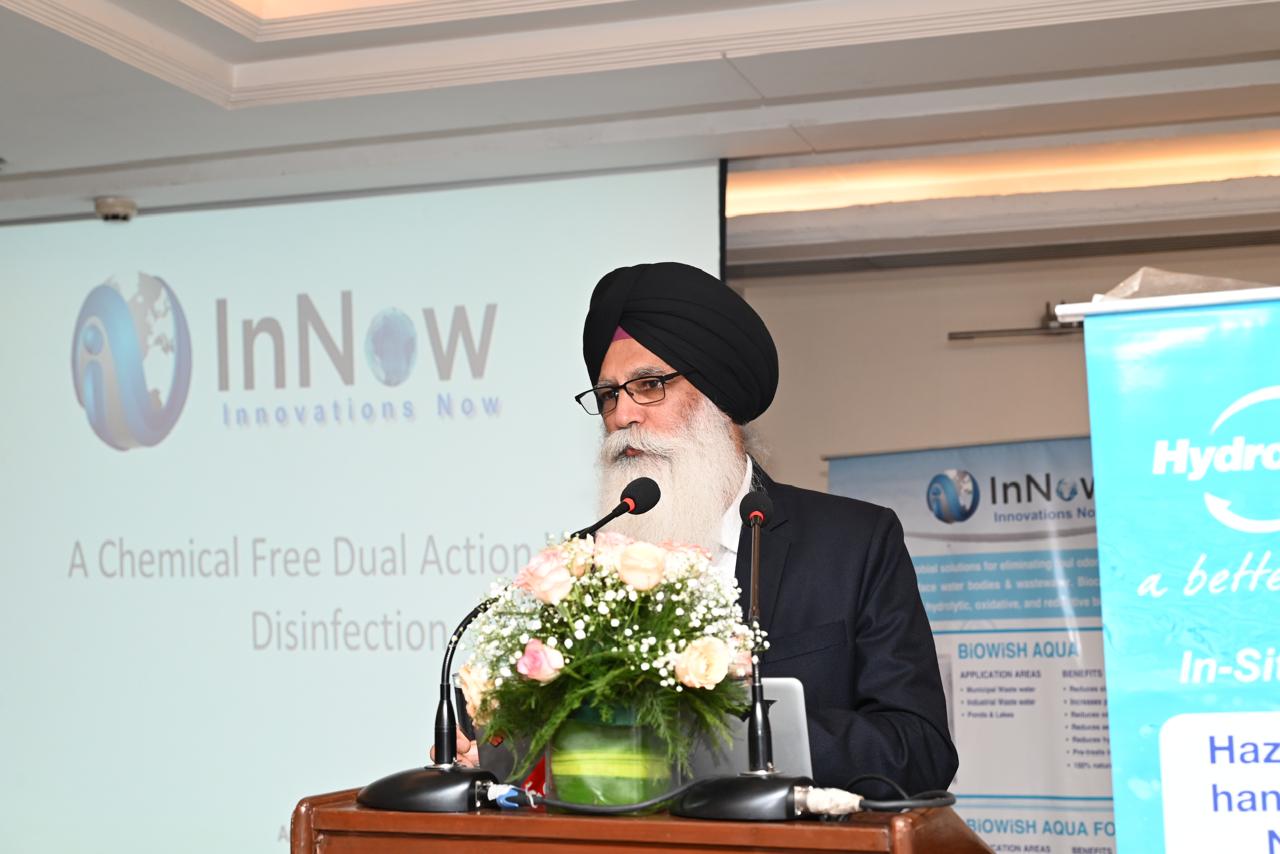
In an interaction with the media, Dr. Lakhwinder Singh Hundal, CEO of INNow India Pvt. Ltd., discusses the need for a more resilient, efficient and data-driven approach to water and wastewater treatment in India. He highlights the importance of continuous water-quality monitoring, decentralised treatment, high-purity water systems for advanced manufacturing, and optimising existing treatment plants. He also emphasises the need to evaluate water-treatment technologies based on lifecycle costs, operational efficiency and long-term performance rather than just initial investment.
1. Water-quality systems are often tested when they are commissioned, but conditions can change every day. Do you believe India needs to move towards continuous water-quality monitoring, and which parameters should institutions be tracking more closely?
Absolutely. A commissioning test only tells us the water quality at one point in time, whereas source water, demand, storage and distribution conditions can change continuously. Institutions should move towards risk- based monitoring of parameters such as turbidity, pH, conductivity/TDS, flow, and disinfectant residual, with periodic microbiological testing for indicators such as E. coli. The objective should be to monitor water from source to treatment, storage and ultimately the point of use, rather than relying only on occasional laboratory reports.
2. India is investing heavily in new water and wastewater infrastructure, but the real test begins after commissioning. What separates a treatment plant that performs reliably for ten years from one that starts underperforming within a few years?
Long-term performance depends less on the sophistication of the technology and more on whether the plant has been designed for the actual operating conditions. Correct process design, good-quality equipment, adequate automation, trained operators, preventive maintenance and regular performance monitoring are all essential for reliable performance. Plants should also be designed for variations in flow and water quality. In my experience, simplicity of operation and strong lifecycle support are often what distinguish a reliable plant from one that gradually loses performance.
3. Do you think India has relied too heavily on large, centralised water and wastewater-treatment infrastructure?
Where can decentralised treatment make more sense – for hospitals, campuses, housing societies, hotels or industrial facilities? Centralised and decentralised systems should complement each other rather than compete. Large centralised infrastructure makes sense where sewer networks and population density support it, while decentralised treatment is particularly useful where wastewater is generated and can be reused at the same location – such as hospitals, campuses, hotels, industries and large residential communities. It can reduce the burden on sewer networks and make local reuse for flushing, landscaping, cooling or other non-potable applications practical. However, decentralisation must still include proper operation, monitoring and accountability.
4. Climate change is making water availability more unpredictable, but it can also change the quality of raw water due to frequent floods, droughts and extreme heat. How should treatment infrastructure be redesigned to cope with these sudden variations?
We can no longer design treatment plants only around an average raw-water condition. Floods can sharply increase turbidity, organic matter and microbial contamination, while droughts can concentrate salts and other contaminants. Treatment systems therefore need greater flexibility through robust pre-treatment, multiple treatment barriers, online monitoring, modular capacity and provision for changing source-water conditions. Climate resilience should mean that treated-water quality remains dependable even when the incoming water changes significantly.
5. India is rapidly expanding manufacturing sectors such as semiconductors, electronics, pharmaceuticals and other high-value manufacturing. How will their requirement and demand for high-purity water change the country’s industrial water-treatment market?
These industries will move the market from simply supplying treated water to delivering extremely consistent and application-specific water quality. Semiconductor and electronics manufacturing require very high-purity process water, while pharmaceutical production demands tightly controlled water systems with strict chemical and microbiological parameters. This will increase demand for advanced membrane and deionisation systems, polishing technologies, real-time monitoring and water recycling. Going forward, suppliers will be often expected to manage the entire water cycle – quality, recovery, reuse and reliability – not merely treatment equipment installation.
6. RO has almost become synonymous with water purification in India, even where it may not always be necessary. How should a customer decide between technologies such as RO, CapDI, filtration, softening and disinfection without over-treating water, excessive water wastage, or wasting money?
Technology selection should always begin with a proper water analysis and the quality actually required for the intended application. RO is appropriate where substantial removal of dissolved salts (TDS) or contaminants is necessary; CapDI can be useful where controlled TDS reduction and higher water recovery are priorities and the feed-water chemistry is suitable. Filtration addresses suspended matter, softening addresses hardness, while disinfection addresses microbial risk. Very often the best solution is a carefully designed combination of technologies. We should first define the treatment objective and then use the most appropriate and effective treatment train rather than automatically specifying RO.
7. Many existing STPs and ETPs have already absorbed significant capital investment but still struggle with performance. How much improvement can be achieved by improving the biology of an existing plant rather than replacing the entire treatment system?
Potentially, a significant improvement – but it would be incorrect to promise one percentage for every plant. In many underperforming STPs and ETPs, the civil infrastructure may still be adequate while the biological process has become unstable and ineffective. Optimising dissolved oxygen, microbial population, sludge age, nutrient balance and hydraulic loading. So, where appropriate the use of bioculture for bioaugmentation or use of advanced biomedia, can improve BOD/COD removal, nitrification, odour and sludge management. The first step should therefore be diagnosing the actual bottleneck before recommending expensive plant replacement.
8. Water-treatment procurement is still often driven by the lowest upfront price. Should buyers instead evaluate technologies on lifecycle cost, energy consumption, chemical dependence, water recovery, downtime and long-term compliance?
Definitely. The lowest purchase price is not necessarily the lowest cost of water treatment over the life of a plant. Buyers should evaluate energy consumption, chemical requirements, water recovery, manpower, consumables, ease of operation, maintenance, sludge or reject disposal, downtime and the cost of maintaining regulatory compliance. A technology with a slightly higher initial investment can be considerably more economical over ten or fifteen years. Procurement should therefore focus on performance, total cost of ownership and guaranteed performance rather than CAPEX alone.
9. For places such as schools, hospitals, hotels and residential communities, what should management actually be measuring to demonstrate that the water being supplied is actually safe – not simply clear or odour-free?
And who should ultimately be accountable for that assurance? Clear water is not necessarily safe water. Management should monitor microbiological indicators such as E. coli, together with turbidity, pH, conductivity/TDS and, in chlorinated systems, free residual chlorine, while source-specific chemical contaminants should also be tested according to the applicable standards. Importantly, samples should be taken not only at the treatment outlet but also after storage and at representative points of use. The facility owner or operator should have primary responsibility, supported by competent laboratories, documented records and clearly defined corrective actions whenever a parameter moves outside specification.
10. With so many new ‘green’ and ‘sustainable’ water technologie s entering the market, how do you distinguish genuine innovation from technology that performs well in a laboratory or pilot scale testing but may not survive real-life field operating conditions?
What evidence should a customer demand before adopting a new solution? A technology should ultimately be judged by evidence, not by how innovative its description sounds. Customers should ask for credible performance data, full-scale field references, results under changing feed-water conditions, energy and water consumption, chemical requirements, maintenance needs, expected component life and evidence of compliance with relevant standards. Pilot trials are useful, but long-term field performance is much more important. Genuine innovation is technology that remains efficient, maintainable and economically viable after it leaves the laboratory and performes under the real- world field conditions.