
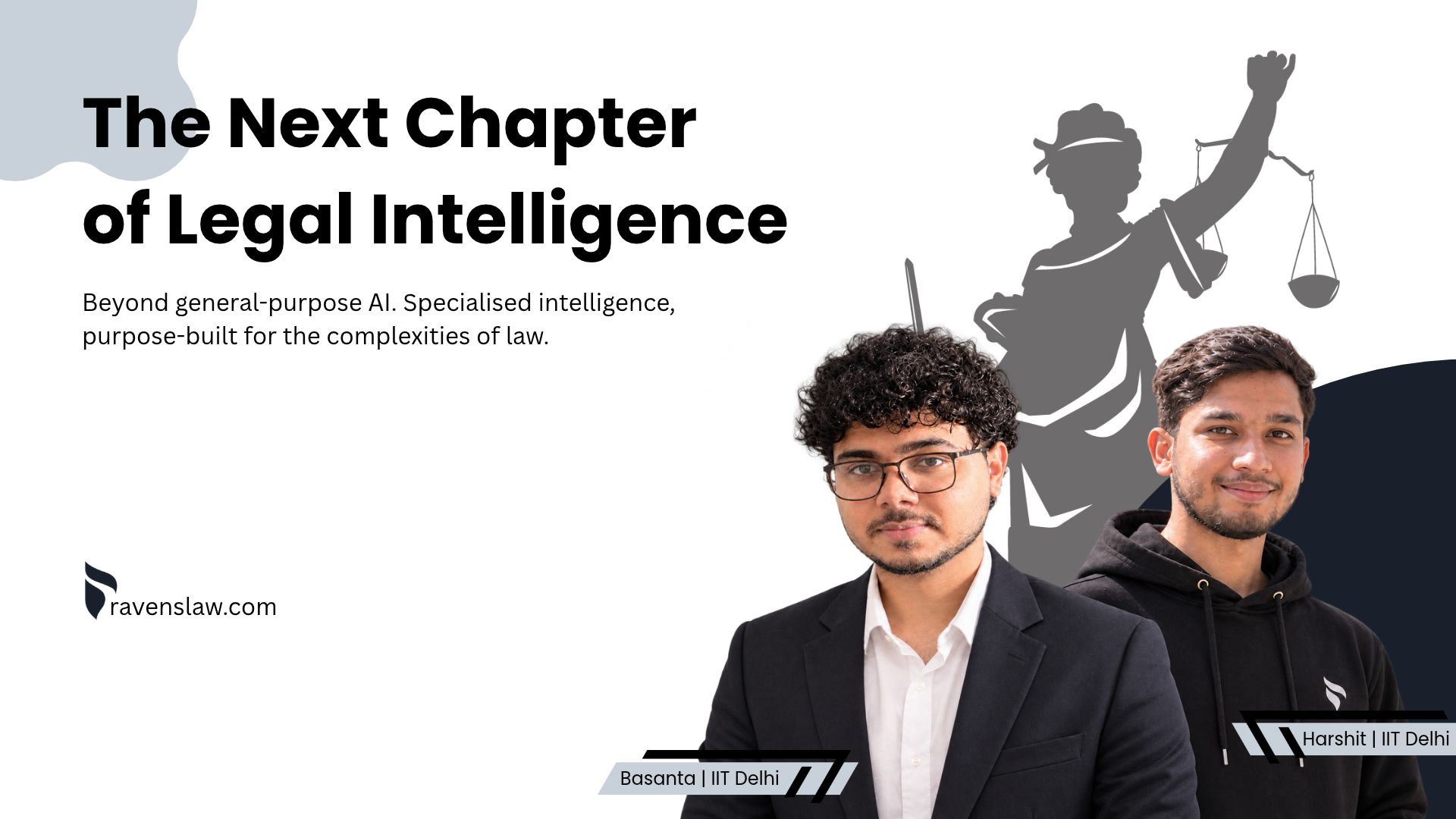
New Delhi: Artificial intelligence is changing how people work, research and access information. But when it comes to the legal profession, simply generating answers is not enough. Understanding laws, interpreting judicial decisions and working through complex legal problems require a much deeper level of reasoning. This is the challenge that RavensLaw, an AI deep-tech startup founded by two IIT Delhi students Basanta Ranjan and Harshit Prabhakar, is working to address.
With a vision to build what it describes as the world’s legal intelligence system, RavensLaw is developing specialised artificial intelligence designed to understand and work with the complexities of the legal ecosystem.
The founders believe that the next significant development in AI will not come solely from advancements in general-purpose intelligence, but from specialised technologies capable of reasoning within complex professional domains. Law, with its extensive frameworks, evolving precedents and jurisdiction-specific requirements, is one such domain.
Rather than positioning itself as another legal chatbot, RavensLaw is working towards building an AI infrastructure that can support deeper legal studies, document analysis, legal reasoning and multi-step professional workflows.
WEBSITE LINK :- ravenslaw.com
- Building More Than a Legal AI Assistant
The company has already developed an AI-powered legal workspace with capabilities covering legal research, document drafting, case-file analysis and document intelligence.
One of its implemented capabilities focuses on AI-powered court filing preparation. The system is designed to process large collections of case-related documents and help organise the information into structured filing materials, potentially reducing the manual effort involved in preparing complex legal documentation. Currently it has a database of over 18 Million judgements where lawyers can work with these data using the help of AI to provide more accurate and relevant legal research
The broader objective is to make AI useful beyond answering individual questions. Legal professionals regularly work with lengthy case records, multiple judicial decisions, procedural requirements and competing interpretations of the law. RavensLaw aims to develop systems that can assist with these interconnected tasks rather than treating every legal query as an isolated interaction.
- A Deeper Approach to Legal Intelligence
RavensLaw’s long-term technology roadmap extends into several areas of specialised AI research and development.
These include training legal AI models using historical judicial decisions, developing systems that can evaluate legal reasoning against actual court judgments, exploring formal verification mechanisms for legal rules and building AI agents capable of simulating opposing legal arguments.
The idea behind these developments is straightforward: legal AI should not simply produce convincing-sounding answers. It should be able to examine the reasoning behind an answer, assess it against relevant legal material and help users consider different perspectives.
Such capabilities could eventually support a wide range of legal workflows, from research and case preparation to complex legal analysis.
- Why India Is the Starting Point
RavensLaw is beginning its journey in India, a country that presents both significant opportunities and technical challenges for legal technology.
With an extensive history of judicial decisions, a complex legal framework, multiple languages and a diverse range of legal institutions, India’s legal ecosystem offers a demanding environment in which to develop and test specialised legal intelligence systems.The founders see this as an important starting point for building technology that can eventually serve legal professionals across different countries and jurisdictions.
The company’s ambition is not limited to lawyers and law firms. Over time, it aims to extend its technology to courts, government institutions and other participants in the global legal ecosystem.
- From Answering Questions to Understanding the Law
The legal industry has traditionally relied on human expertise, extensive analysis and careful interpretation. While AI is beginning to make some of these processes faster, building systems that can work reliably with legal reasoning remains a much larger challenge.
For RavensLaw, that challenge is also the opportunity.
The company is working towards a future in which legal AI can do more than retrieve information or draft documents. Its vision is to develop systems that can understand legal frameworks, examine arguments, evaluate reasoning and assist with complex professional work.
Founded by two IIT Delhi students Basanta Ranjan and Harshit Prabhakar, RavensLaw reflects a broader belief that the future of artificial intelligence will be shaped by specialised systems built for industries where accuracy, context and reasoning matter deeply.
Its journey is still at an early stage, but its ambition is clear: to move legal technology beyond conventional automation and towards a more intelligent infrastructure for the global legal ecosystem.
Because the future of legal AI may not be about getting better answers from a chatbot. It may be about building AI that can understand the law itself.