

You check the label on your moisturiser. You read the back of your cereal box. At some point in the last decade, most of us became rigorous about what we put in and on our bodies. And yet, the one surface we spend more time in contact with than any other; our mattress, gets almost no scrutiny at all.
That is worth examining.
What Is Actually Inside a Conventional Mattress?
A standard memory foam or polyurethane foam mattress is, at its core, a petrochemical product. The base foam is derived from crude oil. To meet flammability regulations, chemical fire retardants are added; historically including compounds like PBDEs (polybrominated diphenyl ethers), linked to hormonal disruption and now banned across the EU and several US states, though replacement chemicals remain in widespread industry use.
That smell when a new foam mattress arrives? That is off-gassing or the release of volatile organic compounds including toluene, benzene, and formaldehyde from the foam and adhesives. Environmental health researchers have documented VOC emissions from polyurethane foam mattresses, with peak concentrations in the first weeks of use. The smell eventually fades. The chemical process that caused it does not stop on the same timeline.
Then there is what happens at the end of a mattress’s life. An estimated 20 million mattresses are discarded annually in the US alone. Polyurethane foam is almost impossible to recycle at scale.The majority ends up in landfill, where it can take over 100 years to break down. In India, mattress disposal is almost entirely unregulated. It is one of the least examined categories of household waste, from a material that is anything but inert.
None of this is alarmist. It is just what the ingredient list looks like when you read it.
So, What Is Kapok?
Kapok is a natural fibre that has been used in bedding across Asia for centuries, long before foam existed. It comes from the seed pods of the Ceiba tree — a tall, wild-growing tree found across India and Southeast Asia. When the pods ripen, they burst open naturally. The silky white fibre inside is hand-collected, cleaned, and carded. No farming. No irrigation. No pesticides. No chemical processing of any kind.
What goes into your mattress is, quite literally, what came off the tree.
The fibre itself is hollow: a natural structure that gives kapok two remarkable properties. First, it does not retain heat. The hollow shaft allows air to circulate continuously, which is why kapok has historically been used in life jackets and why it sleeps significantly cooler than any foam variant. Second, it is extraordinarily lightweight, about eight times lighter than cotton by volume, which gives a kapok mattress a loft and softness that has no synthetic equivalent. At the end of its life, a kapok mattress returns to the earth. No landfill problem. No 100-year decomposition window.
Kapok vs. Memory Foam: The Orthopedic Question
Memory foam earns its orthopedic reputation through viscoelastic pressure relief; the slow-contouring response that moulds to joints and reduces pressure points. For certain sleepers, particularly those managing chronic joint conditions, that response is genuinely useful.
But the orthopedic claim in the mattress industry is largely unregulated. Any brand can print it on a label without clinical validation. And memory foam’s trade-offs are real: it sleeps hot, its support degrades as foam density breaks down over years, and the fixed-contour design means the mattress determines your sleep position rather than responding to it.
Kapok works differently. Because it is a loose fill rather than a moulded block, it distributes body weight evenly and adjusts naturally to movement through the night. For back and side sleepers, a well-filled kapok mattress delivers postural support that follows the body’s geometry rather than imposing a predetermined shape onto it. It is not engineered support. It is natural support, and for most healthy adults, that distinction translates directly into how they feel in the morning.
Kapok vs. Latex: Both Called Natural. Not the Same Thing.
Natural latex is plant-derived but significantly processed. Rubber tree sap is vulcanised and treated with heat and sulphur compounds to produce the foam used in mattresses. Even certified natural latex goes through substantial manufacturing before it becomes a sleep surface. It is natural in origin, industrial in process. There is also a meaningful latex allergy population for whom this is not a preference question but a medical one.
Kapok requires no processing. Amouve sources virgin kapok; first-harvest fibre, uncycled and unblended, which delivers maximum loft, maximum purity, and a performance lifespan significantly longer than recycled-grade fibre. The difference between virgin and blended Kapok is the difference between cold-pressed extra virgin olive oil and a refined blend. Same source, entirely different integrity.
The Supply Chain Behind Every Amouve Mattress
Amouve’s Kapok or silk cotton is hand-harvested by women farmers across tribal and rural communities in central India, regions where the Ceiba tree grows wild and Kapok collection has been a seasonal livelihood for generations. These are not factory workers. They are skilled harvesters who know which pods to pick and when, working within a natural cycle that requires no land clearing, no monoculture farming, and no chemical inputs.
Combine this with the shell casing in organic cotton and the result is a mattress where every material input is traceable, every process is clean, and the communities involved in making it earn a fair return from something the land provides naturally.
Sizes, Customisation, and the Made-to-Order Difference
King size bed at 78 x 72 inches and queen size bed at 72 x 60 inches are the most requested sizes amongst a multitude of other sizes. Non-standard bed frames, specific thickness preferences, firmness levels matched to body weight and sleep position, every mattress is made to specification or customized after ordering, not pulled from a warehouse shelf.
That same philosophy extends beyond the bedroom. Amouve customises virgin kapok for sofa seaters and cushions, floor seating, meditation cushions, bolsters, and reading nooks. Any surface where synthetic foam is currently the default can be replaced with the same two ingredients: virgin kapok and organic cotton.
A foldable single bed format is also available; an organic cotton mattress for guest rooms, children’s rooms, or flexible living spaces that performs like a permanent mattress rather than an afterthought.
The Bottom Line
The average person spends roughly 26 years of their life asleep. That is more time than most people spend at work, more time than they spend eating, travelling, or doing almost anything else. The surface those 26 years happen on has an ingredient list.
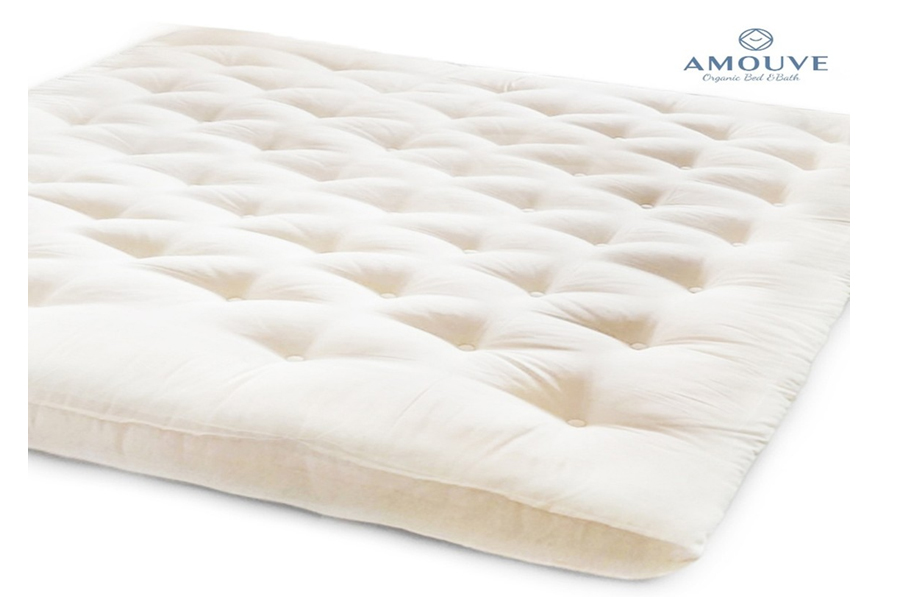
Amouve’s has two items on it. Virgin kapok. Organic cotton.
That’s the whole list.
For enquiries, contact [email protected], or call on +91 8850518520
For more information, www.amouve.com