
What if the life you aspire to create begins with the picture you hold in your mind?
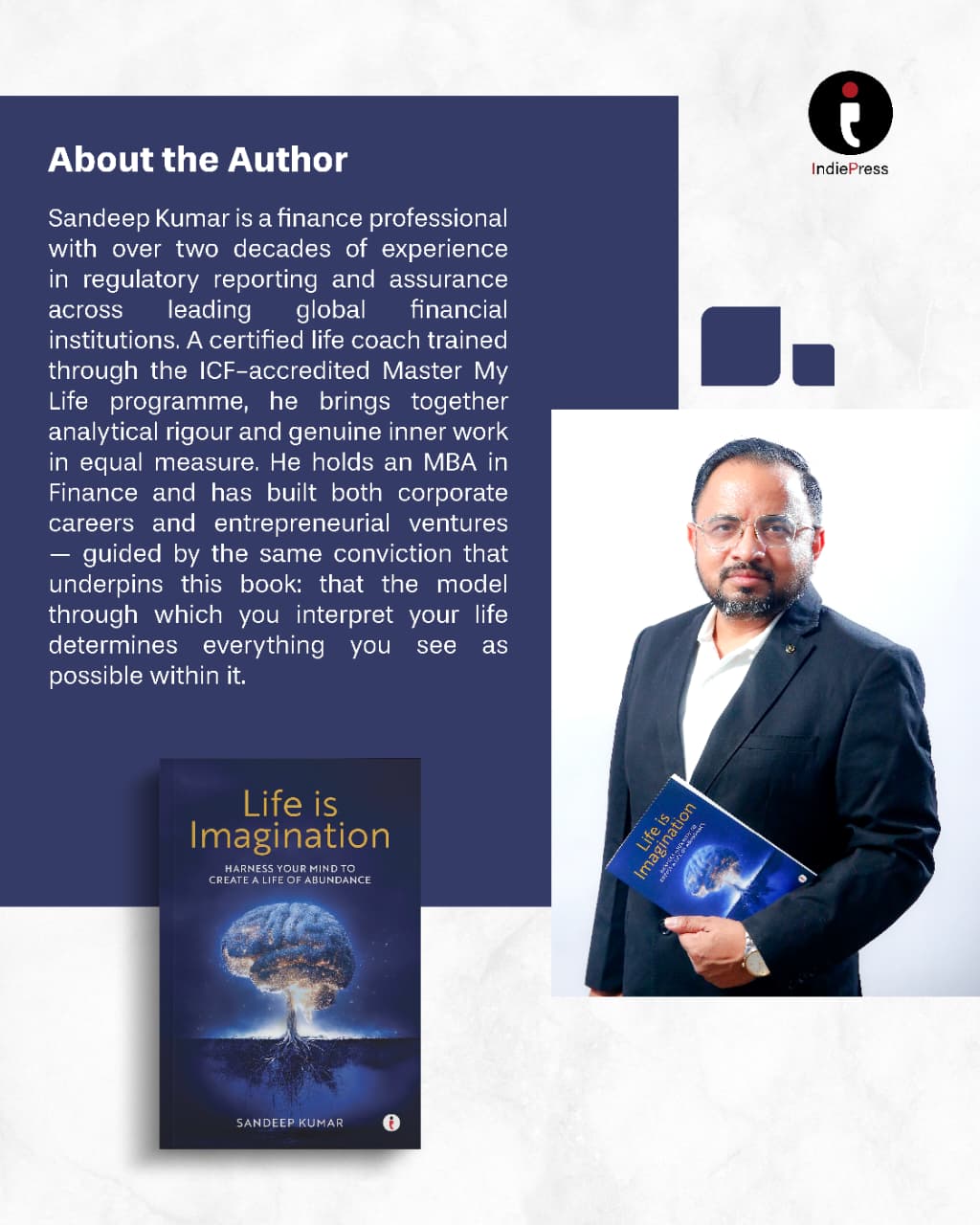
In Life is Imagination, author Sandeep Kumar explores the relationship between imagination, beliefs and the choices that shape our everyday experiences. Moving beyond conventional self-help advice, the book presents imagination as a practical discipline that can help readers reconsider limiting beliefs, develop emotional awareness and align their actions with their aspirations.
Drawing on personal experience, professional insights and his training as a life coach, Kumar invites readers to think of the mind as a fertile garden where every recurring thought is a seed. The question, he suggests, is whether we are cultivating our inner world deliberately or allowing habitual thoughts and assumptions to determine what we believe is possible.
Across twelve chapters, the book explores visualisation, affirmations, personal purpose, relationships, money and spiritual well-being. Its central message is that meaningful transformation does not necessarily begin with dramatic external changes. It can begin with a different thought, a more constructive belief or a small, consistent action repeated over time.
At a time when information overload, social comparison and uncertainty can leave people feeling disconnected from their goals, Life is Imagination encourages readers to develop a more intentional relationship with their thoughts and aspirations.
An Interview with Sandeep Kumar, Author of Life is Imagination
1. Can you provide an overview of your book and how it addresses key challenges in the world today?
Life is Imagination begins with a simple proposition: there is a version of your life that already exists—not in the external world, but in your mind. Many of us spend our lives managing what is in front of us without paying sufficient attention to the inner picture that influences how we interpret our circumstances and what we believe we can achieve.
The book explores imagination not simply as a creative quality, but as a faculty that can be developed and applied intentionally. Across twelve chapters, it moves from understanding imagination to planting beliefs deliberately, visualising with the senses engaged, challenging limiting stories and applying these practices to purpose, relationships, money and spiritual life.
The challenge I wanted to address is widespread but often overlooked. Many capable people today have access to information and opportunities, yet struggle with anxiety, comparison or a sense that they are drifting through a life that appears perfectly fine from the outside.
Sometimes, the issue is not a lack of ability but a mismatch between what a person is capable of and what they believe is possible for themselves.
The book offers a practical approach to closing that gap. It encourages readers to examine their habitual assumptions, cultivate a more constructive inner picture and translate that picture into meaningful action.
2. What inspired you to write this book, and what specific expertise or experiences do you bring to the subject?
I have spent nearly two decades working in regulatory reporting and risk assurance at major financial institutions, beginning with Genpact, followed by HSBC, and continuing at one of the UK’s largest banking groups.
It is precise and demanding work, and it taught me something that eventually extended far beyond banking: the model through which you interpret your data determines what you see. Change the model, and the same information can reveal an entirely different picture.
I began to recognise that our inner lives operate in a similar way. The beliefs we acquire early in life and repeatedly reinforce can become the lens through which we interpret every opportunity, setback and relationship. Often, we mistake these assumptions for objective observations without ever examining them.
My own journey involved learning to question that internal model rather than simply working harder within its limitations. My training as a life coach deepened this understanding, as I encountered similar patterns in the experiences of others.
Life is Imagination emerged from the desire to bring these insights together in a practical and accessible form. My professional background contributes analytical rigour, while my personal experience and coaching training inform the book’s emphasis on reflection, intentional practice and inner development.
3. What are the most valuable insights or takeaways readers can expect from the book?
There are three insights I particularly hope readers take away.
First, imagination is not the opposite of realism. Every significant creation begins as an idea or mental representation before it takes physical form. Imagination can help us identify possibilities, clarify our intentions and prepare ourselves to act.
Second, the mind is a garden. Weeds grow when nothing is planted intentionally, just as unexamined thoughts and assumptions can shape our lives when we allow them to operate automatically. The thoughts we repeatedly return to influence our expectations, decisions and behaviour. Becoming aware of them gives us an opportunity to choose more deliberately.
Third, transformation is often quieter than we imagine. It may look like a thought that once controlled us becoming a conscious choice, a relationship developing greater depth or work beginning to feel more aligned with who we are.
The book does not ask readers to accept a particular framework blindly. Instead, it invites patience, honest self-examination and a willingness to put the practices into action.
4. Can you share real-world examples from the book that illustrate its principles?
Two examples illustrate the ideas particularly well.
The first is the story of Manoj Malik, a mechanical engineer from a middle-class Indian household. After a decade of moving between jobs and entrepreneurial ventures, he had accumulated debt of approximately two crore rupees.
His story, as presented in the book, explores the shift from allowing his immediate financial circumstances to define the limits of his future to cultivating a more constructive and specific picture of what financial possibility could look like. Over time, he worked towards turning that vision into reality.
The lesson is not that imagination alone eliminates debt or guarantees wealth. Rather, it highlights the importance of changing one’s relationship with possibility and connecting that change to sustained action.
Another example is American track-and-field athlete Gabby Thomas. Her mental preparation and visualisation practices, including her approach to recovery, offer an illustration of how athletes can use mental rehearsal alongside physical training and professional support. Her achievements at the Paris 2024 Olympics demonstrate the extraordinary results that can emerge from disciplined preparation and performance.
These examples serve different purposes, but both invite readers to consider how a clearer inner picture can influence the way they approach real-world challenges.
5. What challenges did you encounter while writing the book, and how did you overcome them?
The greatest challenge was finding the right tone.
Writing about imagination and personal transformation presents two risks. One is making exaggerated promises that positive thinking alone can solve every problem. The other is producing an overly academic explanation of the subject that explains the mechanisms without inspiring readers to apply them.
I wanted the book to avoid both extremes. I wanted it to be warm but precise, grounded in evidence while remaining open to the spiritual dimension of human experience.
Achieving that balance required several complete revisions before the voice felt right.
Time was another challenge. I wrote the book alongside a demanding banking career and the responsibilities of a joint family. That experience reinforced one of the book’s central ideas: a vision can exist long before it becomes tangible, but bringing it into the world requires patience and consistent effort.
The book itself began as an idea and gradually became a finished work through the small, deliberate steps that meaningful projects demand.
6. What do you hope readers will gain from the book, and how could it make a positive impact on their lives?
I hope readers finish Life is Imagination with a different relationship to their own minds. Rather than allowing their inner lives to be shaped entirely by habit, circumstance or comparison, I want them to become more intentional about what they cultivate.
Practically, I hope they adopt a few simple practices and make them part of everyday life: a daily visualisation, a method for identifying and rewriting limiting beliefs, and affirmations that feel honest and meaningful rather than hollow.
I also hope readers become more compassionate towards themselves. Change does not require constant striving or harsh self-judgment. It often requires greater awareness, a clearer sense of direction and the willingness to keep taking small steps.
The impact I envision is gradual but meaningful. When individuals become more deliberate about their beliefs and choices, the benefits can extend into their families, workplaces and communities.
Ultimately, I want readers to recognise that while we cannot control every circumstance, we can work on how we understand our experiences and how we respond to them.
7. In a rapidly changing world, how does the book remain relevant over time?
The book focuses on a human faculty rather than a passing trend.
Technology, careers, economic conditions and social expectations will continue to change. The challenges we face may look different from one decade to another, but the need to understand ourselves, make meaningful choices and maintain a sense of direction remains.
Our inner picture influences what we notice, what we pursue and how we respond when circumstances become difficult. Developing a more intentional relationship with that picture can help us remain connected to our goals even when the world around us is uncertain.
In some ways, the faster the external world moves, the more valuable it becomes to have a practice that brings us back to what matters.
I wrote Life is Imagination to be a book readers can return to over time. They might revisit a chapter each season, apply its ideas to a new challenge and discover that the same principles offer different insights at different stages of life.
The intention is not simply to encourage readers to dream, but to help them develop a more deliberate way of turning their aspirations into action.
Begin Creating the Life You Imagine
What if the first step towards a different future were to reconsider the picture you hold of yourself today?
Whether you want to challenge limiting beliefs, develop a clearer sense of purpose, build healthier relationships or approach your goals with greater intention, Life is Imagination offers an invitation to begin that process from within.
Discover how imagination can become a practical part of your everyday life.
Buy on Amazon today and take the first step towards building the life you envision.