

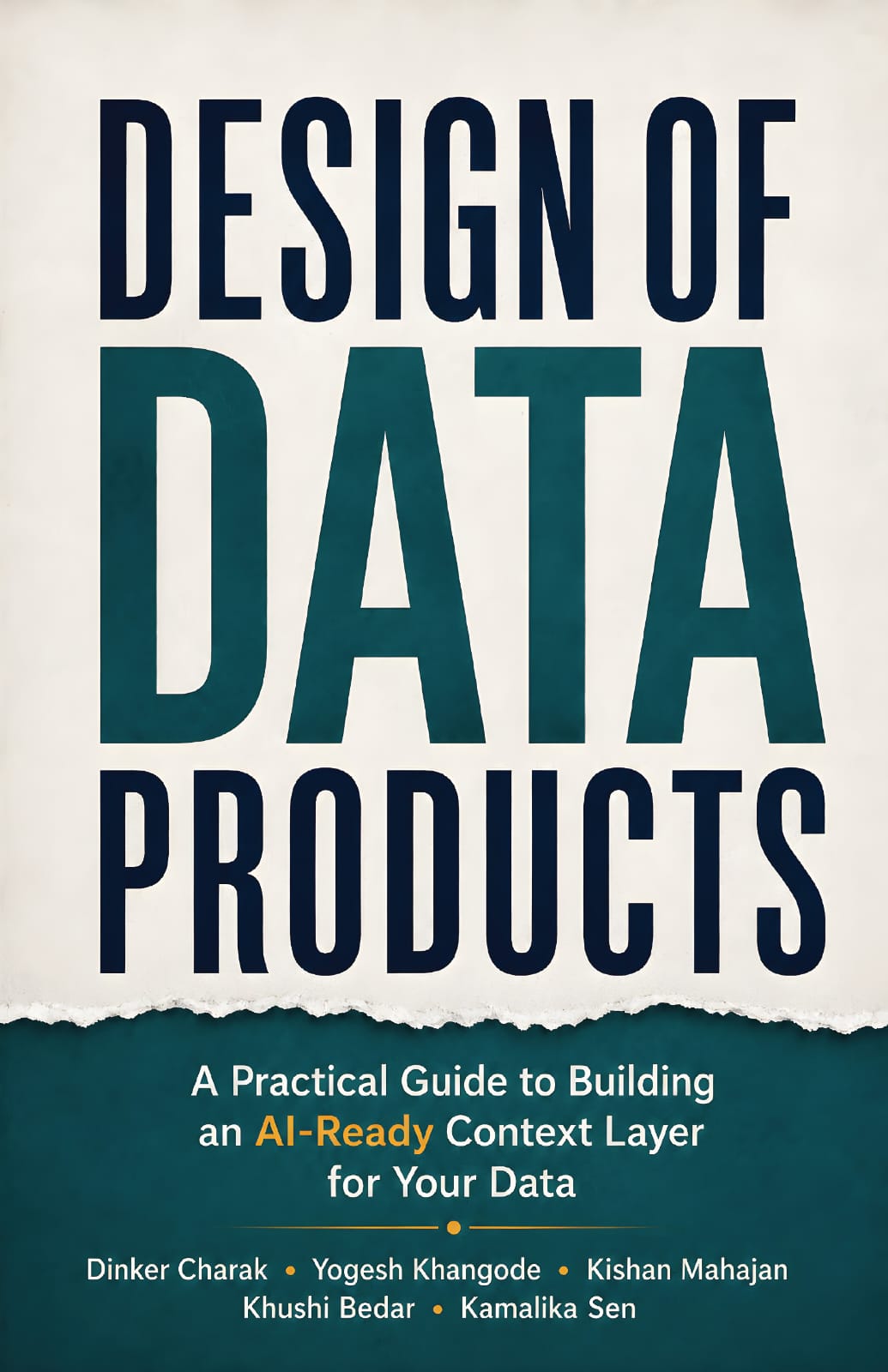
In an era when enterprises are investing heavily in data platforms, business intelligence, and artificial intelligence, the challenge is no longer simply accessing data but making it trustworthy, meaningful, and actionable. Design of Data Products, authored by Dinker Charak, Yogesh Khangode, Kishan Mahajan, Khushi Bedar, and Kamalika Sen, offers a practical guide to designing trusted, reusable, governed, and AI-ready data products. The book begins with a fundamental principle: a data product should start with a business decision that needs to improve, rather than with the data already available.
The book addresses common enterprise challenges, including inconsistent metrics, unclear ownership, disconnected dashboards, low trust, and data that is technically available but not ready for business use. It presents a structured approach to data product design, covering user personas, business outcomes, data domains, semantic models, quality, governance, ownership, and consumption. Through this business-first framework, the authors explain how data products can become more than datasets, pipelines, dashboards, or APIs by connecting technical capabilities with meaningful business outcomes.
Drawing on practical experience across multiple business domains, Design of Data Products combines real-world enterprise scenarios with actionable templates and checklists. From sales performance and customer churn to healthcare claims, inventory availability, and transaction risk, the book demonstrates how data products can support better decisions when designed around clear user needs, trusted metrics, and appropriate governance. It also explores why semantic consistency and governed context are essential for AI readiness, offering professionals a framework that can adapt as technologies, architectures, and business requirements evolve.
1. Can you provide an overview of your book and how it addresses key challenges in the world today?
Design of Data Products is a practical guide to designing trusted, reusable, governed, and AI-ready data products. The book starts with a simple belief: a data product does not begin with data; it begins with a business decision that needs to improve.
Today, enterprises are investing heavily in data platforms, BI, and AI, but many still struggle with inconsistent metrics, unclear ownership, low trust, disconnected dashboards, and data that is technically available but not business-ready. This book addresses that gap. It provides a structured way to move from business context to data product design, covering personas, decisions, outcomes, data domains, semantic models, quality, governance, ownership, and consumption.
It helps teams build data products that are not only technically correct, but useful, trusted, reusable, and ready for human and AI consumption.
2. What inspired you to write this book, and what specific expertise or experiences do you bring to the subject matter?
The inspiration came from seeing data engineering reach a turning point similar to the moment when Agile and Design Thinking changed software development. The idea of the data product is powerful, but there is still confusion about how to design one. Too often, teams define a data product based on what a tool allows them to build. I wanted to offer a business-first and practitioner-led approach instead.
My own background spans product management, engineering, consulting, entrepreneurship, enterprise technology, and data product solutioning. I have worked across domains and have spent significant time helping organizations connect data, business outcomes, and product thinking.
This book also brings together the experience of practitioners who have collectively built more than 1,200 data products across nearly 20 business domains. The goal was to capture that field experience in a usable form.
3. Could you share some of the most valuable insights or takeaways that readers can expect from your book?
The first takeaway is that data products must be designed from business outcomes backward, not from available data forward. The second is that a data product is more than a dataset, pipeline, dashboard, or API. It must carry business meaning, trusted metrics, quality expectations, governance rules, ownership, and a clear consumption path.
The book also shows why semantic models are essential: they translate raw data into business language that people, applications, and AI systems can understand consistently. Another important takeaway is that AI readiness is not achieved by simply connecting an LLM to enterprise data. AI needs governed context, trusted metrics, lineage, access controls, quality signals, and clear usage boundaries.
Finally, readers get practical templates and action checklists they can use in workshops, design discussions, and delivery planning.
4. Can you highlight any case studies or real-world examples from your book that illustrate the principles you discuss?
The book uses practical examples from common enterprise use cases rather than abstract theory. For example, a sales performance data product shows how teams move from a question such as “Are we achieving target?” to the required data domains, including sales, targets, product, region, customer, and salesperson.
A customer churn risk example shows how customer, subscription, product usage, billing, support, and marketing interaction data come together to support intervention decisions. Healthcare and claims examples show why patient, encounter, claim, diagnosis, scheduling, and revenue cycle data must be understood through quality, governance, and sensitive data controls.
Other examples include inventory availability, campaign performance, transaction risk, executive KPI products, and Customer 360. Across these examples, the message is consistent: start with the decision, identify the user, define the metric, design the semantics, and make the product safe to consume.
5. Are there any particular challenges or obstacles you encountered while writing this book, and how did you overcome them?
The biggest challenge was turning a large amount of practical field experience into a clear and reusable method. Data product design sits at the intersection of business, product management, data architecture, engineering, governance, analytics, and AI. Each group uses different language and looks at the problem differently. We had to create a structure that could speak to all of them without becoming too theoretical or too tool-specific.
Another challenge was avoiding the temptation to define data products through technology alone. We addressed this by keeping the book anchored in business decisions, user personas, outcomes, semantics, trust, and consumption.
The action tables and templates at the end of the chapters helped us make the material practical. They turn the ideas into questions a designer can actually use.
6. What do you hope readers will gain from reading your book, and how do you envision it making a positive impact on their lives?
I hope readers gain confidence and clarity in designing data products. A Data Product Manager should be able to use the book as a desk reference to prepare for workshops, ask better questions, define scope, check completeness, and align business and technical teams.
Data Engineers should see how their work connects to business outcomes. Data Architects and Governance Leads should see how semantics, quality, lineage, access, and ownership become part of product design.
The positive impact I hope for is very practical: fewer vague requirements, fewer duplicate dashboards, fewer metric disputes, less rework, more trust, and better adoption. When data products are designed well, teams spend less time debating data and more time making decisions, taking action, and creating business value.
7. In a rapidly changing environment, how does your book stay relevant and adaptable for readers over time?
The book stays relevant because it focuses on enduring design questions rather than temporary tools. Tools will change. Architectures will evolve. AI capabilities will become more powerful. But the core questions will remain: What business problem are we solving? Who is the user? What decision needs to improve? Which data domains are required? What does the data mean? Can the metrics be trusted? Who owns the product? How is it governed? How will it be consumed? What must AI be allowed or not allowed to do?
By answering these questions, readers can adapt the framework to different platforms, industries, and technology shifts. The book is especially relevant in an AI-first world because AI makes context, semantics, governance, and trust even more important, not less.
For Data Product Managers, Data Engineers, Data Architects, Governance Leads, and other professionals working at the intersection of business and technology, the book serves as a practical reference for creating data products that people and AI systems can use with confidence.
Order your copy of Design of Data Products by Dinker Charak, Yogesh Khangode, Kishan Mahajan, Khushi Bedar, and Kamalika Sen on Amazon today and explore a business-first approach to building trusted, reusable, and AI-ready data products.


