
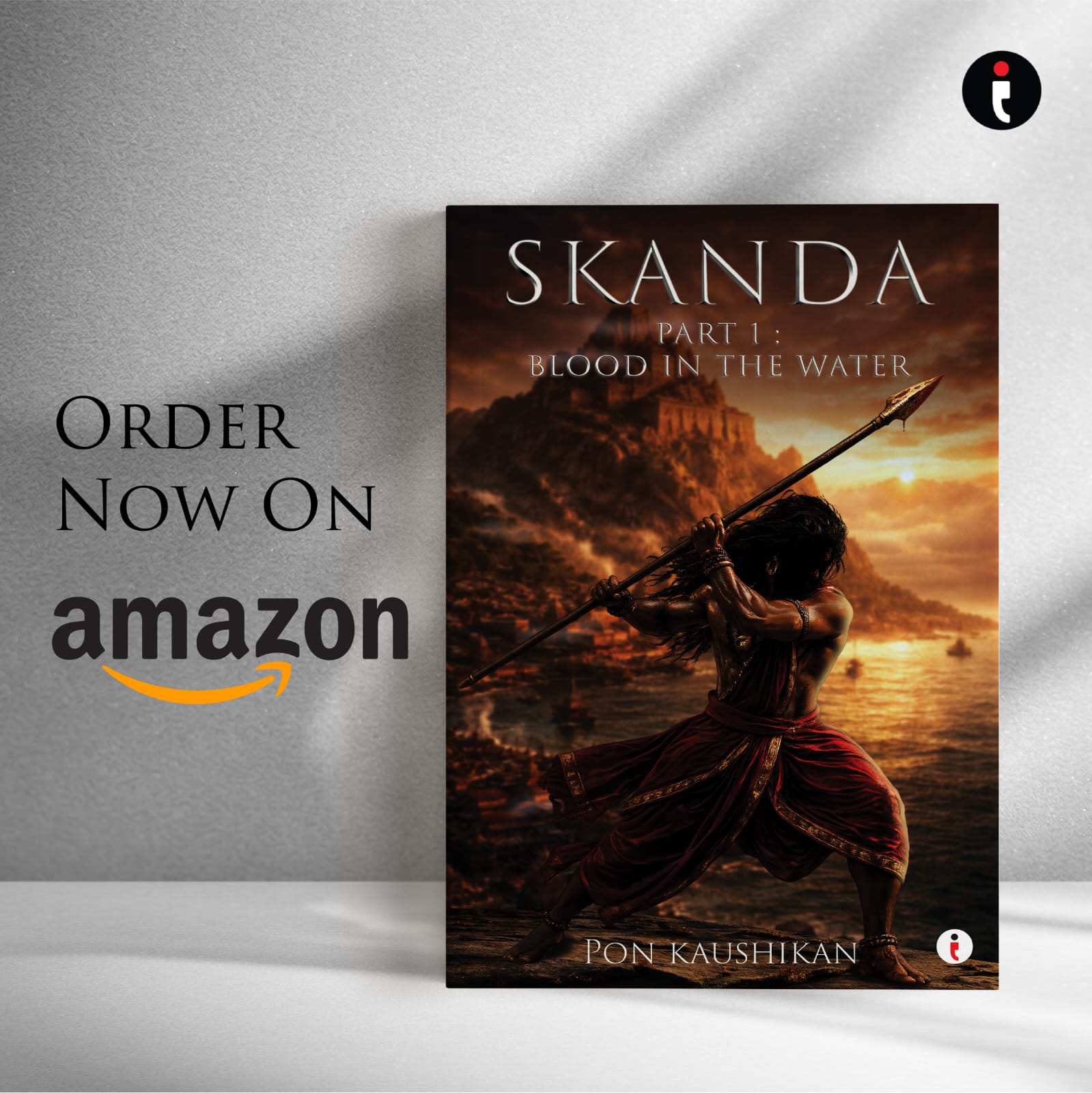
Two timelines. One ancient destiny. A battle that could change the meaning of the past.
In the ancient, pearl-laden port city of Korkai, King Skanda rules at the spiritual heart of the Pandiyan kingdom – a land where the sea carries prayers and ancestral worship runs deep.
But beneath its sacred traditions, the kingdom is on the brink of collapse.
Political deceit spreads through the empire. Crushing taxes fuel unrest. And a fanatical cult known as the Shivanadiyargal rises with a dangerous ambition: to reshape the land through blood and religious fanaticism.
With only the fearless Valli standing beside him, Skanda must fight to protect his kingdom, his people and their right to believe.
Centuries later, in 2023, a lonely and grief-stricken young man named Velan witnesses a mysterious flash of light that shatters everything he believes about his world.
What begins as an inexplicable event soon reveals an ancient connection to forgotten gods, hidden prophecies and a destiny stretching across centuries.
As the two timelines begin to converge, darker forces awaken forces older and more terrifying than the Shivanadiyargal, and feared even by the gods themselves.
Bound by fate, blood and prophecy, Skanda and Velan are drawn into a battle that will determine not only the future, but also the meaning of the past.
Blending Tamil mythology, historical fantasy, time travel, political intrigue and epic adventure, Skanda Part 1: Blood in the Water takes readers into a world of Pandiyan kings, forgotten civilizations, divine powers, betrayal, sacrifice and love.
The battle has only begun.
1. What inspired you to write this particular book, and how did the idea for the story come to you?
I have always been a reader of mythological fantasy. Whenever I went to book fairs, I would run around looking for books in this genre and bring home as many as I could. Amish Tripathi’s books were a great influence on me during those years.
The idea for this particular story was actually quite random. It simply popped into my mind one day, and I have always felt that perhaps it was a gift from my subconscious or maybe even a gift from a greater power.
Once I started writing, something remarkable happened. The story, the characters and the world began to align naturally, and I was genuinely happy to see how everything came together.
What began as an idea eventually became a complete fictional world that I wanted to explore further.
2. Can you share some insights into your writing process? Do you follow a specific routine or have any unique rituals that help you get into the creative flow?
Absolutely.
The research took me a very long time because I was also pursuing my residency in Head and Neck Surgery. It was quite taxing to think about anything other than work, but after a point, the idea of this book became my way of venting out my stress.
Whenever I thought about the story, I felt productive and creatively fulfilled.
For months, I mainly researched and contemplated the world before I actually began writing. Once I started, I wrote whenever I had free time even during the briefest gaps in my schedule. If the OPD was empty and I had ten minutes to myself, I would start writing.
I also set myself a target, and eventually I managed to complete all three parts of the novel within a couple of months.
After finishing each part, I would take a break for about a month. That gave me time to develop new ideas, refresh the characters and return to the story with a clearer mind.
The most difficult part of the writing process was probably what I stopped doing. I completely stopped watching movies and shows while writing because I wanted to avoid unconsciously carrying their impressions, styles or ideas into my own book.
I wanted the world to develop from my own imagination.
3. The characters in your book are quite distinct and memorable. Are they based on real people, or did they evolve purely from your imagination?
Almost all the characters in my novel are imaginary, but they are inspired by real people around me in my everyday life.
Their personalities, appearances, mannerisms and even the way they speak are sometimes influenced by people I have encountered.
The characters are fictional, but real life provided many of their starting points.
I am actually grateful to the people around me because, in one way or another, they have all contributed to my understanding of human behaviour and helped shape the characters in this story.
4. Your book delves into mythology, faith, identity and the relationship between the ancient and modern worlds. What motivated you to explore these themes, and what do you hope readers will take away from your work?
I have always been fascinated by religious worship in our country.
I was never an extremely religious person myself, but I was fascinated by how deeply different gods and traditions are woven into everyday life across different regions and states of India.
One figure who particularly fascinated me was Murugan, or Skanda, and the importance he holds in Tamil Nadu.
What interested me was not simply the idea of Murugan as a god who is worshipped. In many traditions, he is also connected to ideas of ancestry, land and cultural identity. There is a sense of a deeply rooted relationship between the people and the figure they worship.
That made me want to explore what such a world might look like through fiction.
The story therefore grew into a fictional world inspired by these ideas, traditions and cultural memories.
I wanted readers to experience the mythology through a story rather than simply read about it as history or religion.
5. As a writer, how do you balance the need for originality with the expectations of the genre? Were there any challenges in putting your unique spin on familiar elements?
Yes. Since I have been reading this genre for a long time, I was very conscious of not becoming overly influenced by the writers who came before me.
Every author who explores mythology brings their own interpretation, and many have already explored these worlds in considerable detail.
What gave me an advantage, I think, was the geographical and cultural setting.
My story is set in the southern lands of India, particularly within a cultural landscape that I grew up around. Tamil mythology and the traditions of southern India offer an enormous amount of material, but they have not always been explored in mainstream mythological fantasy in the same way as some other Indian mythological traditions.
That gave me an opportunity to present readers with something that felt both familiar and new.
I wanted to bring a world from southern India to the centre of an epic fantasy narrative while remaining respectful of the traditions that inspired it.
“I would never consider storytelling a dying art. Stories are here to stay. They will continue to guide us, entertain us and help us understand ourselves.”
— Pon Kaushikan, author of Skanda Part 1: Blood in the Water
Read Skanda Part 1: Blood in the Water by Author Pon Kaushikan.
The past is calling. The prophecy is awakening.
Order your copy on Amazon today. Begin the journey. Discover the legend. Enter the world of Skanda.