

AIKosh, India’s national platform for AI datasets and models, offered more than 7,500 datasets and 273 models as shared national resources, according to a February 2026 government release. The same release notes that India is developing its own large multimodal AI models, trained on Indian data and languages.
A national repository is a real breakthrough, and it also shows the scale of what comes next. Every model trained on Indian data makes an early choice: record more of the real world or generate synthetic data to fill the gaps. Rwazi records training data on request, in India and across 190+ countries, for teams that hit this gap.
Where synthetic data meets the recording gap
What is synthetic data? Records generated by a model to stand in for recorded ones. It multiplies what a team already holds. A generator can only extend what it was shown, so a model trained this way meets India and misses:
- A dialect the source recordings left out.
- A pack design launched after the generator was trained.
- A street scene in a town the original images never reached.
- A sentence that switches language twice, the way many Indians speak.
Boards want models that work across India, and technical teams are already building. This is where synthetic-heavy projects stall, and the cost is countable: models that score well in testing and slip in the field, retraining cycles that keep coming back, and a pilot that works in one state.
Recorded at the source
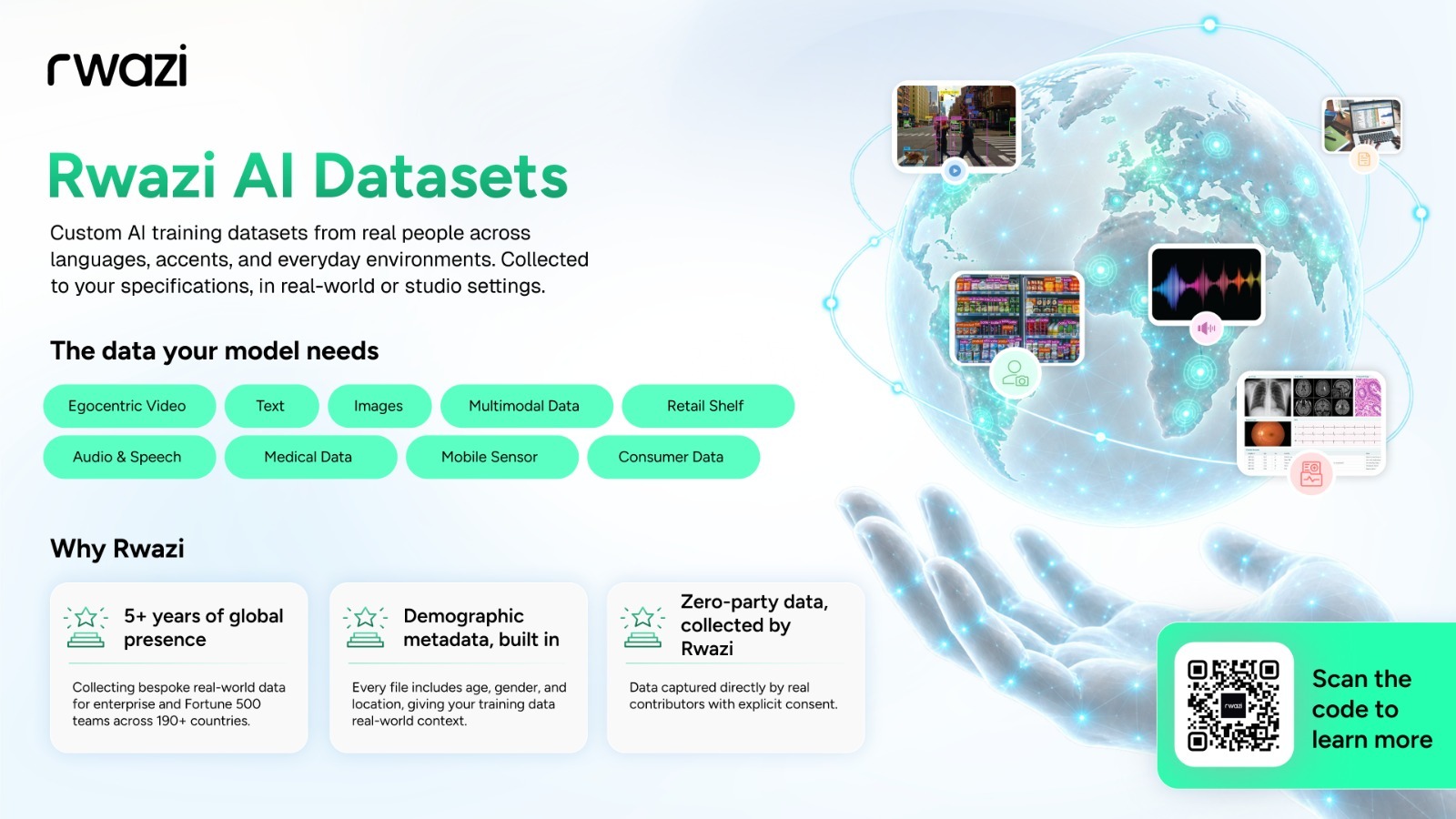
A synthetic file is generated from whatever recordings already exist. A project that needs named districts and languages needs more of the real thing, recorded to a written brief by people paid to supply it. That is the work Rwazi does: real-world AI datasets recorded on request, which give a synthetic set something real to extend.
- An Indian brief usually crosses several types. A speech dataset across accents, noise, and code-mixed sentences.
- An image dataset captured where the model will run, the stage where most computer vision projects in India stall. A video dataset shot to a brief, including first-person capture for robotics.
- Two or more signals are recorded together and aligned for the large multimodal models India is building.
Rwazi records nine types of real-world AI training data, from speech and video datasets to multimodal data, and one brief can mix them. Every item is supplied by the person who recorded it; nothing is inferred. The data collection runs under a master service agreement and a statement of work, with samples checked before anything scales.
Send a brief, and get a sample back. Type, languages, districts, volume, date, or just the one line that matters: what the model keeps getting wrong, and where. Rwazi’s AI datasets team records a sample in the markets with the brief names, with no fee and before any agreement is signed. Send the brief to Rwazi’s AI datasets team.
“Synthetic data is only as Indian as the recordings it started from,” said Joseph Rutakangwa, CEO, Rwazi. “The more of India a model has seen, the less it has to guess.”
What this decides
India has built a national home for AI datasets and is training its own large models. Those models will be judged on whether they work across the country’s languages, districts, and conditions, and that comes down to how much of the real world was recorded rather than generated. The repository came first. The recordings decide what it can teach.


