
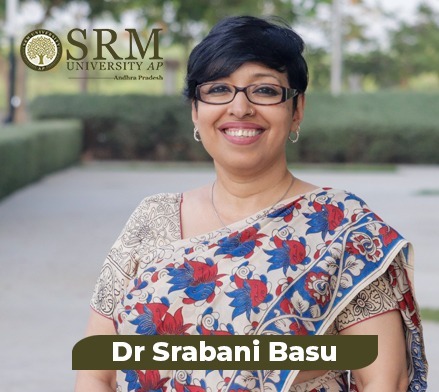
By- Dr Srabani Basu
Associate Professor, Department of Literature and Languages, SRM University AP. ( Amaravati)
Imagine a classroom in 2035. A student raises a hand. “Ma’am, I have a question.” Before the teacher can respond, the student’s AI assistant has generated seventeen answers, compared them across twelve databases, translated them into three languages, converted the most difficult one into a meme, and produced a two-minute video titled Everything You Need to Know Before Your Teacher Finishes Saying ‘Good Question’. The teacher smiles. “Wonderful. Now tell me—which answer do you trust?” Silence. Welcome to education in 2035.
For centuries, education was built around a relatively simple problem: information was scarce, and teachers had access to more of it than students. The teacher knew. The student did not. Therefore, the teacher spoke, the student listened, and somewhere between the blackboard and the examination hall, education was presumed to have happened. That arrangement is already wobbling. By 2035, it may look positively archaeological. Information will no longer be the prized possession of education. It will be the cheapest commodity in the room. Artificial intelligence will retrieve it, explain it, simplify it, visualise it, challenge it and probably apologise for having taken 0.7 seconds to do so.
The great educational question of 2035, therefore, will not be, “What do students know?” It will be, “What can they do with what can be known?” And that changes almost everything. We have spent generations rewarding students for remembering what somebody else already discovered. Define photosynthesis. List the causes of the French Revolution. Explain Hamlet’s tragic flaw. Write 500 words on global warming. In 2035, asking a student to reproduce readily available information and calling it intelligence may be rather like asking someone to memorise the telephone directory and calling them socially connected.
AI will outperform human beings at retrieval. This does not make human intelligence obsolete. It merely exposes how narrowly we have sometimes defined intelligence. The student of 2035 will not need to compete with AI in remembering more. That would be like challenging a calculator to an arithmetic duel. The human advantage will lie elsewhere: asking better questions, recognising nonsense, making connections, exercising judgement, imagining alternatives, understanding context, navigating ambiguity and deciding what ought to be done when several things could be done.
The future classroom, therefore, must move from information to transformation. Information tells me that water boils at 100°C under standard atmospheric pressure. Knowledge helps me understand why. Application allows me to use that knowledge. Reflection makes me ask why millions of people still lack safe drinking water. Transformation asks what I am going to do with that awareness. That final question is where education becomes human.
There is a delicious irony here. We are building extraordinarily sophisticated machines to answer questions at precisely the historical moment when human beings need to become extraordinarily good at asking them. The child who keeps asking “Why?”—currently capable of reducing an exhausted parent to philosophical collapse before breakfast—may possess one of the most valuable abilities of 2035. Curiosity will matter because AI responds largely to the quality of the questions and directions it receives. A student who asks mediocre questions may receive beautifully articulated mediocrity.
The teacher’s role, consequently, changes. The teacher of 2035 cannot merely be an Answer Provider. Teachers will increasingly become architects of curiosity. Instead of asking, “Who knows the answer?” they may ask, “What are we assuming?” “What evidence would change your mind?” “What is missing from this explanation?” “Whose perspective have we ignored?” “What happens if the opposite is true?” And perhaps the most terrifying question ever invented for a classroom: “Why?” No PowerPoint can save you from a determined “Why?”
Critical thinking, meanwhile, may become a form of intellectual self-defence. There was a time when misinformation had to work reasonably hard. Someone had to print it, distribute it and persuade people to read it. By 2035, synthetic text, images, voices and videos may be produced at astonishing scale and sophistication. Something can look authoritative, sound confident, cite impressive-looking sources—and still be spectacularly wrong. The educated person of 2035, therefore, cannot merely be someone who consumes information efficiently. Education will have to cultivate epistemic judgement: How do I know what I think I know?
Students will need to distinguish evidence from assertion, expertise from performance, correlation from causation and confidence from competence. This means examinations must change too. If the task can be completed perfectly by an AI system in twelve seconds, perhaps preventing students from using AI is not the most interesting educational response. Perhaps the task needs redesigning. Instead of “Explain three causes of climate change,” ask students to compare competing explanations, detect misleading claims, defend a decision, identify uncertainty or redesign a solution for a particular community. Assessment must increasingly measure thinking rather than transcription. Otherwise, education may find itself in the curious position of banning the future in order to preserve the examination.
Creativity, too, will have to stop being treated as the decorative cousin of intelligence. For too long, creativity has sometimes been the colourful activity that happens after the “serious learning” is finished. Finish mathematics. Complete science. Submit homework. Then, if civilisation has not collapsed, draw something. The world of 2035 cannot afford that hierarchy. When machines can generate competent conventional answers, human value increasingly moves towards the unconventional: reframing problems, combining unrelated domains, imagining what does not yet exist.
The future may belong to intellectual cross-pollinators. A student might combine literature with coding, psychology with design, biology with ethics, music with mathematics or Shakespeare with software. Indeed, Shakespeare may survive AI rather comfortably. Macbeth is, among other things, a study of prediction, decision-making, cognitive distortion, ambition and what happens when a human being receives extremely persuasive information from a questionable source. In 2035, we may simply call that “using the internet.”
And what of the teacher? Every technological revolution seems to generate the same prediction: teachers will become unnecessary. Books did not eliminate teachers. Television did not. Google did not. Online courses did not. AI will not. But AI may eliminate one version of teaching: the teacher whose primary function is transferring information. And perhaps that is not a tragedy, because teaching was never merely information transfer.
A machine may explain a concept beautifully. But education also requires someone to notice the student who has stopped participating. Someone to challenge intellectual laziness. Someone to recognise potential before the learner recognises it. Someone to create a room in which it is safe to say, “I don’t understand.” Teachers do something that cannot be reduced to content delivery. They create conditions for becoming. The great teacher of 2035 may therefore be less a lecturer and more a mentor, provocateur, curator, coach, questioner and culture architect. The teacher will not stand between the student and knowledge. The teacher will help the student decide what knowledge is worth pursuing—and what kind of person to become while pursuing it.
By 2035, schools may finally have to confront an uncomfortable question: what is education for? If its purpose is merely employability, education will always chase the labour market several exhausted steps behind. Today’s “future-ready skill” can become tomorrow’s automated function. Education must therefore prepare young people not merely for jobs that exist, but for realities we cannot predict. That requires capabilities with longer shelf lives: curiosity, judgement, creativity, empathy, ethics, resilience, communication, self-awareness and the ability to learn, unlearn and relearn. Most importantly, perhaps, it requires the ability to remain human in environments increasingly mediated by machines.
A student may have access to the most intelligent AI system humanity has ever created and still need to answer questions no machine can settle. What matters to me? What is enough? What is fair? What responsibility do I have towards another person? What should I do when efficiency conflicts with compassion? What kind of world is worth creating? These are often called “soft skills.” There is nothing particularly soft about them. They are civilisation skills.
The classroom of 2035 may contain immersive environments, adaptive learning systems, AI tutors, intelligent simulations and technologies whose names we have not yet invented. But somewhere inside all that sophistication, the most powerful educational moment may remain remarkably ancient. A teacher asks a question. A student hesitates. Another disagrees. Someone laughs. Someone says, “But what if…?” The room changes. A possibility appears that did not exist five minutes earlier. That is learning.
Education in 2035 should not aspire to manufacture children who can outperform machines. That competition has already become absurd. It should develop human beings who can work with machines without surrendering judgement to them; who can access infinite information without becoming intellectually passive; who can tolerate uncertainty without rushing towards convenient certainty; and who can remain curious in a world overflowing with answers.
Perhaps, then, the school of 2035 will stop asking children merely, “What do you want to become?” and ask something far more interesting: “What do you want to understand?” And eventually, “What will you do with that understanding?”
Because the future of education will not ultimately be decided by how intelligent our machines become.
It will be decided by how deeply human we choose to remain.