

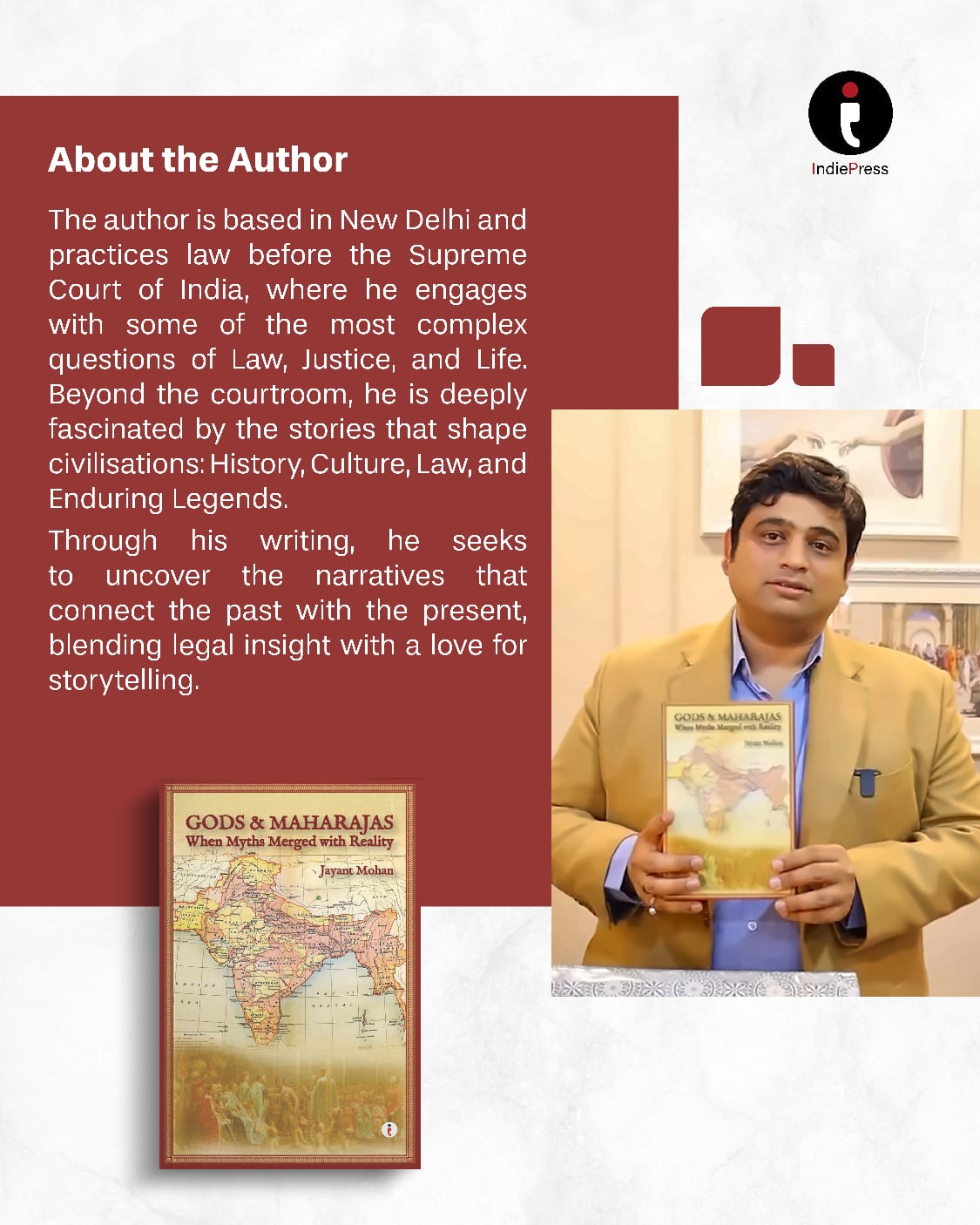
GODS & MAHARAJAS: When Myths Merged with Reality takes readers inside some of the most remarkable courtroom battles in Indian legal history, where ancient traditions, sacred myths, and royal legacies collided with British colonial law.
Following the Revolt of 1857, the British Crown pledged to respect India’s customs, religions, and traditions. This promise placed colonial judges in an extraordinary position. They were required to decide disputes involving faith, caste, temples, inheritance, marriage, kingdoms, and religious customs—often relying on centuries-old beliefs while applying the principles of modern law.
Drawing upon landmark judgments from the Privy Council, High Courts, and the Supreme Court of India, Author Jayant Mohan uncovers the fascinating human stories hidden within these historic legal decisions. Readers encounter courtroom battles over the caste of Chhatrapati Shivaji Maharaj, ownership of sacred hills, temple customs at Badrinath and Kamakhya, the legal status of deities, and the constitutional struggle surrounding the abolition of the Privy Purses.
Blending legal scholarship with engaging storytelling, the book reveals how judges carefully balanced faith, history, evidence, and justice while establishing principles that continue to influence Indian law today. Many of these decisions remain binding precedents and continue to shape contemporary constitutional and religious disputes.
Rich in history, culture, religion, and legal drama, GODS & MAHARAJAS transforms complex judicial decisions into compelling narratives accessible to lawyers, students, historians, policymakers, and general readers alike. It offers a rare opportunity to witness the courtroom as a place where myths met reality, and where legal reasoning helped define the relationship between tradition and modern India.
1. Can you provide an overview of your book and how it addresses key challenges in the world today?
Gods & Maharajas asks a question no other book has: What happens when ancient gods, sacred myths, and mighty kings walk into a modern courtroom? It is a compilation of true stories of landmark cases—from the Privy Council of colonial India to the Supreme Court of today—where judges had to decide the caste of Shivaji the Great, whether a sacred hill can itself belong to the deities worshipped upon it, who has the right to serve God at Badrinath and Kamakhya, and the fate of Maharajas when their kingdoms and Privy Purses vanished.
The world today is wrestling with the same collision of faith, identity, and law—in India and everywhere else. These cases show how wise judges untied that Gordian knot a century ago: with logic, evidence, and deep respect for belief. The disputes are ancient; the challenge is utterly modern. And because of the doctrine of binding precedent, these judgments are not history—they are living law, cited in courtrooms even now.
2. What inspired you to write this book, and what specific expertise or experiences do you bring to the subject matter?
As a practicing advocate in the Supreme Court of India, I kept encountering something remarkable: judgments delivered nearly a hundred years ago—about gods, temples, castes, and kingdoms—still being cited and followed in court today. Behind every dry citation, I discovered an astonishing human story that deserved to be told.
I call it India’s “Mythical Realism.” Just as Latin America gave the world magical realism, colonial India saw two parallel realities collide: the ancient Indian world of miracles, myths, and maharajas, and the modern Western world of rationality and evidence, meeting before English-educated judges. Years of arguing cases taught me to read judgments not merely as law but as literature—courtroom dramas with more twists than a Netflix series. I wrote this book so readers could experience them that way too.
3. Could you share some of the most valuable insights or takeaways that readers can expect from your book?
A few revelations surprise almost every reader:
- Courts never judge whether a belief is true. The only legal question is whether someone’s right of worship is actually being interfered with—a principle laid down in 1933 in the battle between two Jain sects over the sacred Parasnath Hill.
- Faith cannot confer title. The sanctity of a place is a matter of belief; ownership of land is a matter of evidence. That very principle travelled from the Privy Council in 1933 into the Supreme Court’s Ram Janam Bhoomi judgment of 2019.
- Custom can prevail over the general law—but it must be proved like any other fact. Ancient usage, once established, is respected by the most modern of courts.
- Judicial wisdom is sometimes knowing what not to decide. In the case concerning the caste of Shivaji the Great, the judges deliberately refrained from recording a finding that could prejudice his descendants—statesmanship worthy of the words on our national emblem: Satyamev Jayate.
4. Can you highlight any case studies or real-world examples from your book that illustrate the principles you discuss?
Every chapter is a real case, and each one reads like a story.
- The caste of Shivaji the Great—a courtroom was asked to rule on the lineage of the founder of the Maratha Empire, the validity of “sword marriages,” and the rights of children born from them.
- The sacred hill that went to trial—Digambar and Shwetambar Jains fought over Parasnath Hill. Could belief in its sanctity make the hill itself the property of the deities? The answer helped shape the Ayodhya verdict decades later.
- The idol without eyes—in 1970, the Supreme Court held that placing chakshus (eyes) on an idol worshipped in its formless Nirakar state interfered with the worshippers’ rights.
- The Pandas of Badrinath and the Daloi of Kamakhya—who may serve God, and who may collect dakshina?
- The Maharajas’ last stand—the Privy Purses case, where India’s former rulers challenged the Union of India before the Supreme Court after being derecognised.
5. Are there any particular challenges or obstacles you encountered while writing this book, and how did you overcome them?
The greatest challenge was translation—not between languages but between worlds. These judgments lie buried in dense Victorian prose, colonial gazetteers, and old law reports. My task was to excavate the human drama within them without sacrificing a lawyer’s accuracy. Every fact had to be verified against the original records, and every faith had to be treated with the respect it deserves while its claims were being legally analysed.
I overcame it with a simple rule I learned at the Bar: tell the story first; the law will follow. Each chapter begins with the people—the sects, the priests, the princes—and ends with the lessons in judicial wisdom their cases teach. If a reader who has never entered a courtroom can feel the suspense of the verdict, the chapter has done its job.
6. What do you hope readers will gain from reading your book, and how do you envision it making a positive impact on their lives?
I want readers to discover that court judgments are not intimidating documents—they are some of the finest human stories ever written, full of kings and gods, faith and betrayal, loss and restoration. A reader who finishes this book will understand today’s headlines on temple disputes, religious rights, and personal laws far more deeply because they will know where those debates began.
More than anything, I hope the book offers reassurance: emotionally charged questions of religion and identity can be resolved with poise, reason, and dignity. The judges in these pages did exactly that, a century ago, in far more difficult times. That is a lesson in wisdom every citizen, not just every lawyer, can carry into daily life.
7. In a rapidly changing environment, how does your book stay relevant and adaptable for readers over time?
Because of a beautiful paradox at the heart of our legal system: the principle of precedent. The myths in this book are thousands of years old, and the judgments interpreting them are a century old—yet they influenced the Ram Janam Bhoomi case in 2019, and they will continue to influence cases tomorrow. A ruling on the Daloi of Kamakhya from about a hundred years ago remains binding law. In law, the past is never past.
As long as India—and the world—continues to debate faith, custom, caste, and the rights of belief, courts will return to these first principles. Gods & Maharajas is adaptable by design: the stories are eternal, the questions are timeless, and the law that answers them is still alive. That is why these ancient stories will remain as relevant tomorrow as they were before Independence.
Ready to discover the extraordinary courtroom battles where myths, faith, kings, and colonial law shaped modern India? GODS & MAHARAJAS: When Myths Merged with Reality offers a fascinating blend of history, religion, culture, and legal drama through landmark cases that continue to influence Indian law today.
Buy your copy on Amazon today and experience the remarkable true stories where myths merged with reality.