
The Designers Shaping the Future of Indian Luxury Fashion Through Innovation, Aesthetic Identity, and Progressive Couture Language
Indian couture is no longer confined to bridalwear or ceremonial dressing. A new hierarchy has emerged—one driven by artistic identity, silhouette innovation, material experimentation, global red-carpet relevance, and the ability to create a recognisable visual universe. These designers are not merely selling garments; they are shaping modern Indian luxury culture through strong aesthetic authorship and progressive design language.
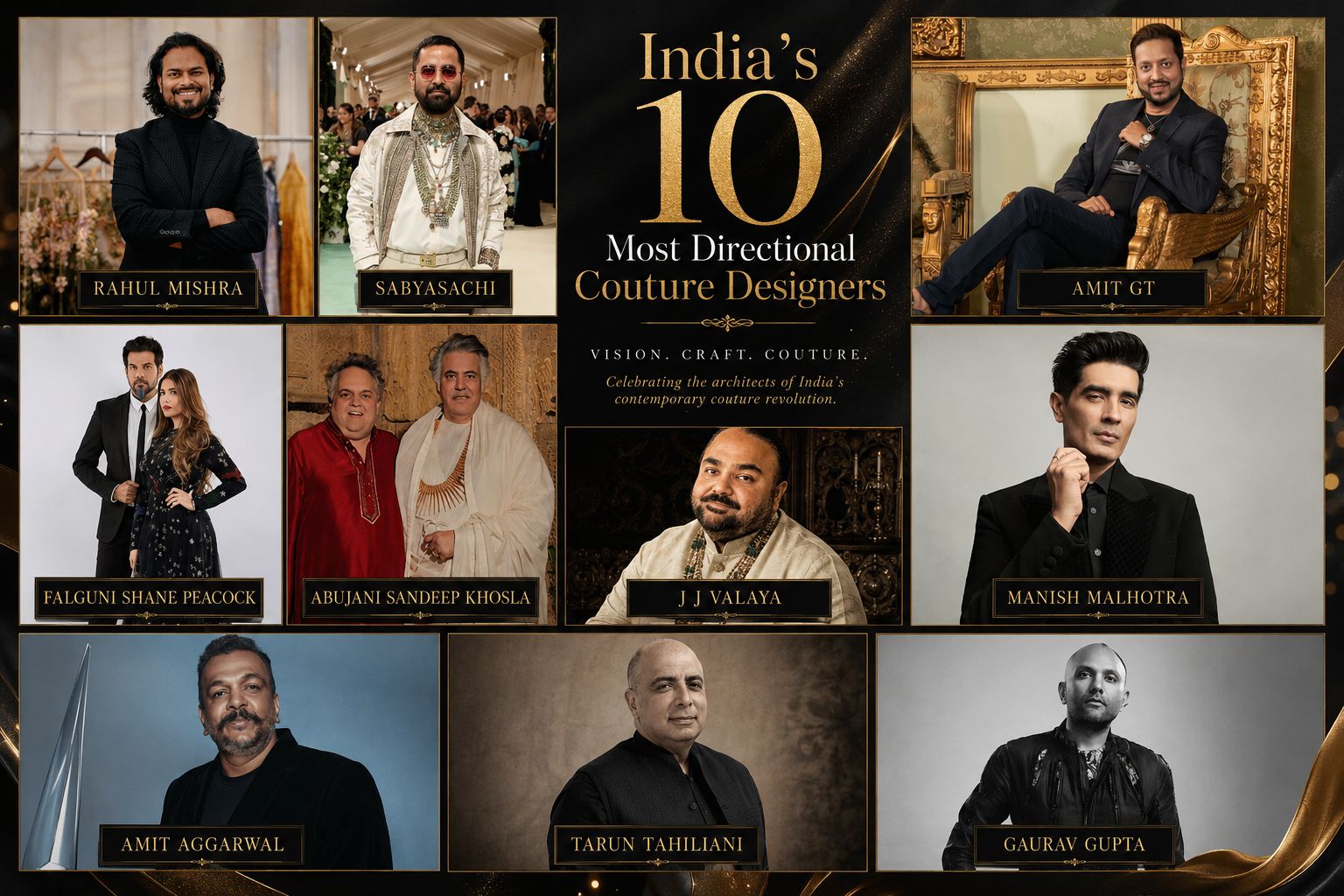
1. Rahul Mishra
Rahul Mishra represents the intellectual and artisanal evolution of Indian couture. His work transcends fashion and enters the realm of wearable art, where embroidery becomes storytelling and nature becomes architecture. By bringing Indian craftsmanship to the Paris Haute Couture platform, he shifted global perception of Indian fashion from decorative to conceptual. His couture speaks to collectors, not just consumers.
2. Gaurav Gupta
Few Indian designers have built a silhouette language as instantly recognisable as Gaurav Gupta. His sculptural drapes, fluid metallic constructions, and futuristic glamour have positioned him at the forefront of avant-garde couture. International celebrities increasingly gravitate toward his work because it feels cinematic, directional, and globally contemporary rather than regionally referential.
3. Amit Aggarwal
Amit Aggarwal redefined modern Indian couture by merging textile innovation with architectural construction. His use of recycled materials, polymer textures, engineered pleating, and futuristic draping created an entirely new couture vocabulary within India. He sits at the intersection of sustainability, experimentation, and luxury—making his work feel progressive without losing wearability.
4) Falguni Shane Peacock
Falguni Shane Peacock introduced unapologetic spectacle into Indian couture. Their work embraces maximal embellishment, structured sensuality, and performance-driven glamour. Unlike traditional bridal houses, they positioned Indian couture within the language of global celebrity dressing, creating looks designed for stage presence, red carpets, and visual impact rather than quiet tradition.
5) Tarun Tahiliani
Tarun Tahiliani remains one of the most refined aesthetes in Indian couture. While many designers leaned into theatrical maximalism, Tahiliani mastered fluidity, proportion, and draped sophistication. His fusion of Indian craftsmanship with European structure changed the trajectory of modern Indian bridalwear, introducing effortless luxury and quiet opulence into a category once dominated by excess.
6) Manish Malhotra
Manish Malhotra modernised glamour for the Indian mainstream and luxury market simultaneously. His couture thrives on celebrity culture, cinematic polish, and instantly aspirational dressing. While his work is often associated with Bollywood grandeur, his real achievement lies in creating a scalable luxury fashion ecosystem spanning couture, beauty, jewellery, and cultural influence.
7) Amit GT
Amit GT often called The Elie Saab of India.
Amit GT’s couture language is rooted in glamour, precision embellishment, and high-impact femininity, but increasingly shaped through a more international red-carpet lens. The brand’s strength lies in balancing sensuality with couture drama—particularly through crystal work, sculpted silhouettes, and cinematic styling. Its evolving aesthetic positions it closer to global eveningwear houses than traditional bridal couture systems.
8) Sabyasachi
Sabyasachi transformed Indian bridalwear into a complete luxury ecosystem. More than clothing, he built a cinematic world rooted in nostalgia, heritage, and emotional storytelling. His greatest innovation lies not in silhouette experimentation, but in aesthetic consistency and brand mythology. Few Indian designers have created a visual identity as culturally dominant or commercially influential.
9) JJ Valaya
J.J. Valaya belongs to the generation that established Indian couture as a luxury discipline. His aesthetic combines regal India with European sophistication, resulting in couture that feels aristocratic yet timeless. While newer designers chase disruption, Valaya’s relevance lies in preserving grandeur through meticulous craftsmanship, heritage storytelling, and polished visual restraint.
10) Abujani Sandeep Khosla
Abu Jani Sandeep Khosla remain masters of ceremonial opulence. Their couture celebrates Indian maximalism through chikankari, mirror work, zardozi, and extravagant surface detailing. What makes them enduring is their refusal to dilute extravagance in an era of minimalism. Their work continues to define the visual language of India’s grandest weddings and cultural celebrations.
The Shift in Indian Couture
The future of Indian couture is increasingly being shaped by designers who possess a distinct aesthetic universe rather than simply technical craftsmanship. Innovation today is no longer limited to embroidery—it includes silhouette engineering, textile experimentation, visual storytelling, global relevance, branding sophistication, and the ability to create emotionally recognisable fashion identities.
The new hierarchy belongs to designers who are not only preserving Indian craftsmanship, but also translating it into a language the global luxury market understands.